Rule 54(b) Strikes Twice . . . in the Same Case.

Case:  Beverly Enterprises Inc. v. Keaton (Beverly II)

Appellate Practice Tip:  Before appealing, make certain that all claims against all parties are either properly dismissed (meaning that a court order is entered) or adjudicated.  Otherwise, the order from which you are appealing is a non-final order, and the Supreme Court will refuse to reach the merits of the appeal. See Ark. R. Civ. P. 54(b).

Case ExplanationThe Arkansas Supreme Court’s recent decision in Beverly Enterprises Inc. v. Keaton (Beverly II) represents the second time that the same case has been dismissed without prejudice as a result of a Rule 54(b) problem. 2011 Ark. 7; see also Beverly Enterprises, Inc. v. Keaton, 2009 Ark. 431 (Beverly I).

The Plaintiff in Beverly filed suit both individually and in her capacity as administratrix of the estate. Beverly I, 2009 Ark. 431, at 1.  In the original lawsuit, there were three defendants, all of which were business entities that were affiliated with Beverly Enterprises, Inc. (the “Beverly Defendants”). Beverly I, at 2.  There were five claims alleged in the original complaint:

  1. Violation of the duty of care under the Arkansas Medical Malpractice Act;
  2. Violation of the general duty to provide adequate and appropriate custodial care and supervision;
  3. Violation of the Arkansas Long Term Care Resident’s Rights Statute;
  4. Deception in representing that they could provide proper care; and
  5. Violation of the Arkansas Deceptive Trade Practices Act.

Id. at 2.

The plaintiff later amended her complaint to add a breach of fiduciary claim against the Beverly Defendants, and also added an additional Beverly entity and nine Beverly executives as defendants on that claim. Id. at 2.  The amended complaint also added a claim for violation of the Uniform Fraudulent Transfer Act against all of the above defendants, as well as one other individual and five other entities. Id. at 2-3.

The claims and parties are somewhat complicated, so they are summarized in the table below.  To add some level of clarity, the parties referred to in this blog post as the “Beverly Defendants” are indicated in orange.

Source Document Claim Defendants
Original Complaint Violation of Arkansas Medical Malpractice Act
  • Beverly Enterprises, Inc.
  • Beverly Health and Rehabilitation Services, Inc.
  • Beverly Enterprises – Arkansas, Inc., d/b/a Beverly Healthcare – Camden)
Original Complaint Violation of General Duty To Provide Adequate and Appropriate Custodial Care
  • Beverly Enterprises, Inc.
  • Beverly Health and Rehabilitation Services, Inc.
  • Beverly Enterprises – Arkansas, Inc., d/b/a Beverly Healthcare – Camden)
Original Complaint Violation of Arkansas Long Term Care Resident’s Rights Statute
  • Beverly Enterprises, Inc.
  • Beverly Health and Rehabilitation Services, Inc.
  • Beverly Enterprises – Arkansas, Inc., d/b/a Beverly Healthcare – Camden)
Original Complaint Deception by Representing Ability To Provide Proper Care
  • Beverly Enterprises, Inc.
  • Beverly Health and Rehabilitation Services, Inc.
  • Beverly Enterprises – Arkansas, Inc., d/b/a Beverly Healthcare – Camden)
Original Complaint Violation of Arkansas Deceptive Trade Practices Act
  • Beverly Enterprises, Inc.
  • Beverly Health and Rehabilitation Services, Inc.
  • Beverly Enterprises – Arkansas, Inc., d/b/a Beverly Healthcare – Camden)
Amended Complaint Breach-of-Fiduciary Claim
  • Beverly Enterprises, Inc.
  • Beverly Health and Rehabilitation Services, Inc.
  • Beverly Enterprises – Arkansas, Inc., d/b/a Beverly Healthcare – Camden)
  • Beverly Indemnity, Ltd.
  • William R. Floyd
  • Douglas J. Babb
  • David R. Devereaux
  • Jeffrey P. Freimark
  • Cindy H. Susienka
  • Patrice K. Acosta
  • James M. Griffith
  • Patricia C. Killing
  • Richard Skelly, Jr.
Amended Complaint Violation of Uniform Fraudulent Transfer Act
  • Beverly Enterprises, Inc.
  • Beverly Health and Rehabilitation Services, Inc.
  • Beverly Enterprises – Arkansas, Inc., d/b/a Beverly Healthcare – Camden)
  • Beverly Indemnity, Ltd.
  • William R. Floyd
  • Douglas J. Babb
  • David R. Devereaux
  • Jeffrey P. Freimark
  • Cindy H. Susienka
  • Patrice K. Acosta
  • James M. Griffith
  • Patricia C. Killing
  • Richard Skelly, Jr.
  • Rubin Schron
  • Fillmore Capital Partners, LLC
  • Fillmore Strategic Investors, LLC
  • Pearl Senior Care, Inc.
  • PSC Sub, Inc.
  • Geary Property Holdings, LLC

At a pretrial hearing, the plaintiff’s attorney acknowledged that no wrongful death claim had ever been alleged against any defendant, and also announced to the court that an agreement had been reached under which the plaintiff would nonsuit all claims against all defendants, except for the claims against the Beverly Defendants. Beverly I, 2009 Ark. 431, at 3.  On the first day of trial, an order was entered dismissing with prejudice the plaintiff’s wrongful death claim.

After a jury trial, a judgment was entered against the Beverly Defendants on the negligence claims, and a punitive damages award was entered against two of those defendants. Id. at 3.  A separate judgment was entered the same day declaring the Civil Justice Reform Act’s limitation on punitive damages unconstitutional. Id. at 3.  However, no order was entered adjudicating the other claims or the other defendants. Id. at 3.

The Beverly Defendants appealed, but the Arkansas Supreme Court refused to reach the merits of the case. Id.  The Court quoted Arkansas Rule of Civil Procedure 41(a), which provides that a dismissal without prejudice by a plaintiff “is a matter of right, it is effective only upon entry of a court order dismissing the action.” Id. at 4.  Based on this, and based on Rule 54(b), the Court held that “a judgment is not final if it has not adjudicated all the claims against all the parties.” Beverly I, 2009 Ark. 431, at 4.

In Beverly I, only the negligence claims against the Beverly Defendants had been adjudicated. Id. at 5.  The other claims and other parties had been neither properly adjudicated nor dismissed. Id. at 5.  In essence, all of the claims and all of the parties in the chart above remained unadjudicated and not dismissed, except for the negligence claims against the Beverly Defendants.  Therefore, the Supreme Court dismissed the appeal without prejudice.

Beverly II represented the second attempt to appeal the case.  After the dismissal without prejudice in Beverly I, the trial court entered an order dismissing “with prejudice all of the Plaintiff’s claims against the Defendants save and except for the Beverly Defendants.” Beverly II, 2011 Ark. 7, at 1-2.  It appears that this order properly dismissed all of the claims against the defendants who were added in the amended complaint (the defendants listed in the table above in black text).  However, there were still claims remaining against the Beverly Defendants that still had not been adjudicated or dismissed. Id. at 2.  Therefore, the Supreme Court held that the “remaining claims against Beverly must be properly adjudicated or dismissed before this court acquires jurisdiction to hear the appeal.” Id. at 2.

Arkansas appellate attorneys should be very careful about Rule 54(b) problems, as both the Arkansas Supreme Court and Arkansas Court of Appeals are very particular about compliance with the rule.  Even where a plaintiff intends to waive certain claims, and even where it is clear from the transcript that the plaintiff intended to waive the claims, it is important to review the pleadings and orders to make certain that all claims against all parties have been adjudicated or dismissed.

Related Posts:

UPDATE: Arkansas Supreme Court Election Results: Judge Karen Baker Wins Election for Position 6

With 78% of the precincts reporting, the Arkansas Democrat Gazette has called the election for Position 6 on the Arkansas Supreme Court for Judge Karen Baker.  Judge Baker led by a slim margin early in the night, but took a bigger lead as the night continued.  The race in Pulaski County (Judge Fox’s home county) was close, with Judge Baker edging out Judge Fox 51% to 49%.  In Judge Baker’s home county (Van Buren County), Judge Baker defeated Judge Fox by 73% to 27%.  As of the time this post was published, Judge Fox had won or was leading in the following counties: Ashley, Perry, Polk, Prairie. and Sevier.  Several other counties had not yet reported results.

Judge Karen Baker currently serves as the Court of Appeals Judge for District 2, Position 2.  She was elected to that position in 2000 and re-elected in 2004 (Act 1812 of 2003 reapportioned the Court of Appeals districts and required a new election for this position in 2004).  Judge Baker’s eight-year term on the Court of Appeals will end in 2012.  It is expected that Governor Mike Beebe will appoint a replacement for the vacancy that will be created when Judge Baker takes office as an Associate Justice on the Arkansas Supreme Court in January, 2011.

Judge Tim Fox was elected to serve as a Pulaski County Circuit Court judge in 2002 and then re-elected to another six-year term in 2008.

UPDATE: As of 6:00 p.m. on November 3, 2010, 98% of precincts are reporting the following results in the Supreme Court Election:  Baker 388,530 (61%), Fox 252,639 (39%).

Arkansas Business Analyzes Supreme Court Election Spending

Arkansas Justice Building--Home of the Arkansas Supreme Court and Arkansas Court of Appeals

In its October 25 issue, Arkansas Business published an article detailing the amount of money spent on Supreme Court races in Arkansas.  The articles provides a thorough analysis on the issue of money and judicial elections, both on the state level and from a national perspectives.  Some statistics of note:

Click here for a link to the article.

UPDATE: Arkansas Supreme Court Clarifies Original and Appellate Jurisdiction for Constitutional Amendments: Forrester v. Daniels.

UPDATE Below the Jump:

The Arkansas Supreme Court handed down its decision today in Forrester v. Daniels, clarifying that it has original jurisdiction over challenges to constitutional amendments that are initiated by the citizens, but appellate jurisdiction over challenges to constitutional amendments referred by the legislature. Forrester v. Daniels, 2010 Ark. 397.  This has been the rule for many years, but had been called into question after amendment 80 to the Arkansas Constitution became effective on July 1, 2001. See Becker v. McCuen, 303 Ark. 482, 708 S.W.2d 71 (1990).

Because the Court did not reach the merits of the Petitioner’s case, this blog post will not discuss the merits in detail, but will only address them briefly.  The proposed amendment at issue here deals with the maximum interest rate that can be charged by various entities, and also deals with the power of governmental units to issue bonds. Forrester, 2010 Ark. 397, at 2-4.  The gist of the challenge is that the legislature attempted to cover too many issues in a single proposed amendment.  Id. at 3-4.

The importance of this case, however, is more procedural in nature.  Because, as discussed above, the status of the Supreme Court’s jurisdiction (original or appellate) was in doubt after the enactment of Amendment 80, the Petitioner filed nearly identical actions in the Pulaski County Circuit Court and the Arkansas Supreme Court, both on the same day.

A proposed constitutional amendment may appear on the ballot by one of two methods.  The first is by referral from the legislature, the requirements of which are provided in at Arkansas Constitution Article 19, § 22.  The second method is through the initiative and referendum power reserved to the people.  This procedure is outlined at Arkansas Constitution Amendment 7.

Amendment 7, dealing with amendments resulting from initiatives of the people, provides that “[t]he sufficiency of all state-wide petitions shall be decided in the first instance by the Secretary of State, subject to review by the Supreme Court of the State, which shall have original and exclusive jurisdiction over all such causes.” Ark. Const. Amend. 7.  Article Nineteen, Section 22 of the Arkansas Constitution has no such provision, so the Arkansas Supreme Court in Becker held that it did not have original jurisdiction, but had only appellate jurisdiction pursuant to Article 7, § 4 of the Arkansas Constitution. See Becker, 303 Ark at 482, 708 S.w. 2d at 71.

The reason this is an issue in Forrester is that Article 7 was repealed by Amendment 80 of the Constitution.  Amendment 80 provides, in part, that “[t]he Supreme Court shall have . . . [o]riginal jurisdiction to determine sufficiency of state initiative and referendum petitions and proposed constitutional amendments.” Ark. Const. Amend. 80, § 2(D)(4).  Because the provision conferring original jurisdiction on the Arkansas Supreme Court includes the phrase “and proposed constitutional amendments,” the Petitioner argued that the Arkansas Supreme Court now has original jurisdiction over all proposed constitutional amendments, and not just those resulting from initiatives. See Forrester, supra.

In a unanimous opinion, the Arkansas Supreme Court disagreed.  The Court held in Forrester that the phrase “and proposed constitutional amendments” must be read in the context of the phrase “to determine sufficiency of.” Forrester, 2010 Ark. 397, at 8-9.  According to the Court, that phrase only makes sense if “proposed constitutional amendments” refers only to amendments that result from initiatives from the people, as those are the only types of amendments subject to a sufficiency challenge. Id.  For proposed amendments referred from the legislature, the only question is “whether the procedures governing the method for the legislature to propose an amendment have been followed.” Id.

In an interesting paragraph at the end of the opinion, the Court then seemed to look at its own rules to help it interpret the constitutional issue.  The Court noted that it had amended its rules to conform to the changes resulting from Amendment 80.  After the changes, Rule 6-5 read as follows:

(a) Original Jurisdiction. The Supreme Court shall have original jurisdiction in extraordinary actions as required by law, such as suits attacking the validity of statewide petitions filed under Amendment 7 of the Arkansas Constitution or, where the Supreme Court’s contempt powers are at issue.

Ark. Sup. Ct. R. 6-5(a) (2010).

In Forrester, the Court held its conclusion was “further bolstered” by the fact that it had amended the rules in response to Amendment 80, but had done so “in a way to indicate that our jurisdiction of the instant challenge is now original.” Id. at 9-10.  Arkansas appellate lawyers should bear this in mind when dealing with procedural issues before the Arkansas Supreme Court, as the Court seems willing to look to its own rules to help it interpret constitutional provisions.

Continue reading “UPDATE: Arkansas Supreme Court Clarifies Original and Appellate Jurisdiction for Constitutional Amendments: Forrester v. Daniels.”

UPDATE: Arkansas Supreme Court November 2010 Runoff Election Update: Judge Karen Baker v. Judge Tim Fox

The election to fill the vacancy left by Arkansas Supreme Court Justice Imber’s retirement from the court late last year is less than three weeks away. The election, a runoff election between Arkansas Court of Appeals Judge Karen Baker and Pulaski County Circuit Court Judge Tim Fox, is being held because neither of the three candidates in the May 18 election received a majority of the votes. In the May election, Judge Karen Baker received 48% of the vote, Judge Tim Fox received 37% of the vote, and Evenlyn Moorehead received the remaining 15% of the vote.

This race is the only Appellate Court race that will be on the ballot in the general election on November 2, 2010.  Because of this, the race has garnered quite a bit of attention from the media in the last few weeks.  Below are links to stories that have been published about the race recently.

ArkansasAppeals.com will continue to post articles about the judicial race as they become available.  Also, you can keep an eye on our blog and on our Twitter feed on election night for continuing updates on the election.


No Streaming Video Feed of Today’s Arkansas Supreme Court Oral Argument in Texarkana

The Arkansas Supreme Court is conducting its oral argument this morning in Texarkana, Arkansas, at the Arkansas High School Student Union.  The case to be argued is Brandon Lacy v. State (CR09-1340).  Because this case is not being argued in the Supreme Court’s courtroom (where the video cameras for live streaming online videos are installed), there will be no video feed of today’s oral argument.

Today’s oral argument in Texarkana marks only the eleventh time in modern times that the Arkansas Supreme Court has held court away from Little Rock.  Amendment 80 to the Arkansas Constitution, which was adopted in 2000, provides that the Supreme Court may meet at such times and places as designated by the Court.  For more information on today’s event, which is open to the public, view the press release issued by the Administrative Office of the Courts.

UPDATE: West Memphis 3 Case to be Argued September 30th at Arkansas Supreme Court (Live Video Stream Available)

The Arkansas Supreme Court will hear oral arguments on September 30, 2010, in the case of Damien Wayne Echols v. State of Arkansas

A notice issued today by the Administrative Office of the Courts provides that although seating will be limited in the courtroom itself, there will be an overflow room set up at the Justice Building to accommodate those who wish to attend the argument in person and who are unable to get a seat in the courtroom.  The notice also reminds the public that the arguments can be viewed live online through the Court’s new video feed of oral arguments. 

To view the oral argument live from your computer, visit the Oral Argument Video page at the Arkansas Judiciary Website or click on the link to that page at the top of the sidebar to your right (under Live Feed of Oral Arguments).  

Today’s notice also provides that on September 30, 2010, the Justice Building will be open at 7:30 a.m. and seating will be on a first-come, first-served basis, with only 15 seats reserved for the media.  The following rules will be enforced for those in attendance at the September 30th oral argument:

  • Everyone who enters the building must go through security.
  • No signs, shirts, buttons, or other displays in support of or against any party in this case or related cases will be allowed (anyone wishing to hold signs or other information must do so outside, although the streets, sidewalks, and entrances must remain unobstructed).
  • No weapons of any kind will be permitted.
  • No cameras or recording devices will be permitted in the courtroom.
  • No umbrellas allowed.
  • No buttons, shirts, or signs supporting any party involved in a case will be permitted.
  • No campaign material permitted.
  • Phones must be turned off in the courtroom.

The William H. Bowen School of Law plans to stream the arguments in the Echols case in the Friday Courtroom on September 30, 2010.  The law school’s event will be open to the public.

UPDATE:  On November 4, 2010, the Arkansas Supreme Court handed down its opinion in the West Memphis 3 cases.  The Court reversed and remanded for an evidentiary hearing and reconsideration of the motion in light of the proper interpretation of the statutes. See Arkansas Supreme Court: West Memphis 3 Cases Reversed and Remanded.

8th Circuit’s Local Rules to Require Electronic Filing Beginning October 1, 2010

United States Court of Appeals for the Eighth Circuit

The rules of appellate practice are changing for appellate attorneys who practice in front of the United States Court of Appeals for the Eighth Circuit.  Beginning October 1, 2010, the Eighth Circuit will require that all appellate briefs be filed electronically. 

The Arkansas Law Review blog has done a nice job of summarizing the rule changes–check out their summary by visiting their blog post entitled 8th Circuit Revised Local Rules Adopt a Mandatory Electronic Filing Requirement, Effective October 1st.

The Arkansas Appeals Blog Welcomes The Arkansas Appellate Cycle Blog to Arkansas’s Appellate Practice Blogosphere

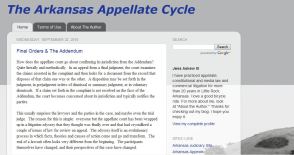
The Arkansas Appellate Cycle Blog

The Arkansas Appeals Blog welcomes the newest Arkansas appellate practice blog on the scene: The Arkansas Appellate Cycle.   

Authored by Jess Askew III of Williams & Anderson, The Arkansas Appellate Cycle Blog combines information about appellate practice and procedure with Mr. Askew’s more than twenty years of experience as an appellate attorney in Arkansas.  In his blog posts, Mr. Askew creatively weaves his love for cycling with his passion for appellate practice to provide a helpful frame of reference outside of the law that often helps him explain legal minutiae.  Mr. Askew describes his goal with the blog as follows:  

My goal is to have a conversation about appellate practice in the state courts of Arkansas, and the cycling perspective can help make a point or two along the way. There is also the natural metaphor between the journey of a bike trip and the life of a lawsuit, from trial through appeal. I hope the cycling perspective will make this blog more accessible and enjoyable.  

Check out Mr. Askew’s most recent blog post entitled Final Orders & The Addendum for an example of how he creatively connects the cycling process to Arkansas’s appellate cycle.  

Mr. Askew’s resume as an appellate practitioner is impressive.  He began his legal career as a law clerk to the late Richard S. Arnold, who sat as a judge and later as Chief Judge on the United States Court of Appeals for the Eighth Circuit.  Mr. Askew has been involved in numerous cases on appeal, including the recent cases of Arkansas Blue Cross v. Little Rock Cardiology Clinic, 551 F. 3d 812 (2009), dealing with federal ancillary jurisdiction in a health-care case; Arkansas Democrat-Gazette v. District Court, Ark. S. Ct. No. 08-1435 (Dec. 18, 2008), establishing the availability of a writ of certiorari from a circuit court to an inferior court under Amendment 80 to the Arkansas Constitution; and Cox v. Daniels, 374 Ark. 437 (2008), rejecting a ballot-title challenge to the Arkansas College Scholarship Lottery Amendment under Amendment 7 to the Arkansas Constitution.  Additionally, Mr. Askew was a contributor to the Arkansas Bar Association’s treatise on Handling Appeals in Arkansas.  Mr. Askew is listed in Best Lawyers in America under appeallate practice.

The experience and knowledge Mr. Askew brings to The Arkansas Appellate Cycle Blog makes it a great new resource for Arkansas appellate lawyers.  To follow the blog, click on the links provided in this post or click on the link to The Arkansas Appellate Cycle Blog in our list of Blog Links included in the sidebar to the right.