Arkansas Supreme Court Rules Act 1 Unconstitutional

The Arkansas Supreme Court, in a unanimous decision handed down this morning, affirmed the Pulaski County Circuit Court’s decision ruling that Act 1 is unconstitutional as a violation of fundamental privacy rights under the Arkansas Constitution.

The following is a link to the Court’s Decision: DHS v Cole Opinion

Act 1–also known as the Arkansas Adoption and Foster Care Act of 2008–was approved by Arkansas voters by a vote of 57% on November 4, 2008.  Act 1, which went into effect on January 1, 2009, prohibits an individual from adopting or serving as a foster parent if that individual is “cohabiting with a sexual partner outside of a marriage that is valid under the Arkansas Constitution and the laws of this state.” Ark. Code Ann. Section 9-8-304(b).  The prohibition on adoption and foster parenting “applies equally to cohabiting opposite-sex and same-sex individuals.” Ark. Code Ann. Section 9-8-304(b).

In today’s opinion, the Arkansas Supreme Court announced its holding concerning the constitutionality of Act 1 as follows:

We hold that a fundamental right to privacy is at issue in this case and that, under the Arkansas Consitution, sexual cohabitors have the right to engage in private, consensual, noncommercial intimacy in the privacy of their homes.  We further hold that this right is jeopardized by Act 1 which precludes all sexual cohabitors, without exception, from eligibility for parenthood, whether by means of adoption or foster care. 

Proposed Changes to Arkansas Appellate Court Rules Affecting Civil Practice

The Arkansas Supreme Court delivered a per curiam opinion on March 3, 2011, in which the Court announced proposed changes to rules of procedure affecting civil practice.  See In Re Arkansas Rules of Civil Procedure and Rules of the Supreme Court and Court of Appeals, 2011 Ark. 99.

The following rule changes to the Arkansas Rules of the Supreme Court and Court of Appeals were proposed by the Arkansas Supreme Court Committee on Civil Practice and are being suggested by the Arkansas Supreme Court: 

  • Rule 2-1. Motions, general rulesThe change would require that motions filed in the appellate courts comply with the style of appellate court briefs.  Currently the rules governing the style of briefs are more specific than the rules governing the styles of motions.  Based on this rule change, motions would be required to be in 14-point font, among other things.
  • Rule 4-1. Style of briefsThis change would increase the page numbers in the Appellant’s reply brief from 15 to 20 pages.  When the Court previously changed Rule 4-1 to require 14-point font to be used in briefs filed in appellate courts, the number of pages for the appellant’s brief and the appellee’s brief was increased by 5 pages.  This rule change would also add an additional 5 pages to the reply brief.  
  • Rule 4-2. Contents of briefsThe statement of the case would increase from a maximum of 5 to a maximum of 6 pages.  This change is also in response to the previous increase in the font size of appellate court briefs from 12 to 14 point font.
  • Rule 6-7. Taxation of costsThis change would increase the total costs for the filing fee that is recoverable by the prevailing party to $165.  This change would reflect the actual cost of filing an appeal in the appellate courts (to include the addition of the $15 technology fee that was previously added to each filing fee).
  • Rule 6-9. Rules for appeals in dependency-neglect casesThis amendment would add a motion to intervene in dependency-neglect proceedings to the list of appealable orders under the expedited appeal procedure of Rule 6-9.

If you wish to comment on these proposed rule changes, make your comments in writing before May 1, 2011, to: Leslie W. Steen, Clerk, Supreme Court of Arkansas, Attn.: Civil Procedure Rules, Justice Building, 625 Marshall Street, Little Rock, Arkansas 72201.

Judge Posner, the Blue Book, and Arkansas Citation Resources

Judge Richard Posner, of the U.S. Court of Appeals for the Seventh Circuit, created quite a stir lately with his law review article in the Yale Law Journal, in which he criticized the Blue Book’s citation format.  Though his article criticizes many aspects of the Blue Book (its size, for example), he is particularly critical of its system of abbreviation:

An example that I have picked literally at random is “C.Ag.” What does “C.Ag.” stand for? Why, of course, the Código de Águas of Brazil. Now suppose one had occasion to cite the Código de Águas. Why would one want to abbreviate it? The abbreviation would be meaningless to someone who was not a Brazilian lawyer, and perhaps to Brazilian lawyers as well (but do  they abbreviate  Código de Águas “C.Ag”?).  The basic rule of abbreviating, ignored by the authors of The Bluebook, is to avoid nonobvious abbreviations: don’t make the reader puzzle over an abbreviation, as  The Bluebook does routinely. Consider “Temp. Envtl. L. & Tech. J.,” “ILSA J. Int’l & Comp. L.,” “Emp. Rts. & Emp. Pol’y J.,” and “AIPLA Q.J.” These are names of journals. Now try figuring out “B.T.A.M. (P-H),” “A. Ct. Crim. App.,” “A.F. Ct. Crim. App.,” “C.G. Ct. Crim. App.,” “N-M  Ct. Crim. App.,” “Ne. Reg’l Parole Comm’n,” and “Cent. Ill. Pub. Serv. Co.” What is the point? It’s as if there were a heavy tax  on letters, making it costly to write out Coast Guard Court of Criminal Appeals instead of abbreviating it “C.G. Ct. Crim. App.”

Judge Posner is so dissatisfied with The Bluebook that he has drafted his own citation manual, which is used by the clerks who assist him in drafting his opinions.  The manual is approximately three pages long (or, in Judge Posner’s words, “one one-hundredth  the length of  The Bluebook”).

While Arkansas appellate attorneys might not want to rely on Judge Posner’s 3-page manual when drafting appellate briefs in Arkansas, there are resources available to Arkansas attorneys (in addition to the Blue Book) that can assist with proper citation in appellate court briefs.  The website of the Arkansas Reporter of Decisions provides several of these resources: 

  • The House Style Guide–One of the most helpful resources provided by the Reporter of Decisions is the House Style Guide, which is the style guide used by the Arkansas appellate court judges and their law clerks when drafting opinions.  The House Style Guide provides information on Arkansas citations as well as punctuation, word usage, possessives, and other grammar and stylistic conventions used by Arkansas’s appellate courts.
  • Citations Guidelines–For a brief overview of citations to opinions of the Arkansas Supreme Court and Arkansas Court of Appeals, the Citations Guidelines page is also helpful.  
  • Citations Page–the Citations Page provides more detailed citation examples, including examples of citations to opinions of appellate courts of all 50 states, along with various rules, law reviews, and other materials.

For more information about how use the new citation format in Arkansas pursuant to Arkansas Supreme Court Rule 5-2(d)(2), check out our previous blog post on the topic, Using Arkansas’s New Citation Format.

If you want even more information about using citations in Arkansas trial court and appellate court briefs, the UALR William H. Bowen School of Law will be hosting a free CLE on Monday, March 7 at 11:30.  The CLE, entitled Citation Insights: The Bluebook, the ALWD Citation Manual, and the Arkansas Supreme Court’s Citation Rules and Practices, will be presented by Professor Coleen Barger.  Attorneys who attend can receive 1 hour of CLE credit.  There is no charge for the CLE, but there is a $5 charge for lunch.  If you plan to attend, please email Haley Walker at hewalker@ualr.edu.

Related Posts:

Arkansas Times: Judge Ray Abramson To Run For Arkansas Supreme Court

The Arkansas Times is reporting that Judge Ray Abramson, who is currently serving in an appointed position on the Arkansas Court of Appeals, will run for the Arkansas Supreme Court in 2012.  He would be running for Arkansas Supreme Court Associate Justice Jim Gunter‘s seat.  Justice Gunter has not announced whether he will seek re-election to that seat.

Rule 54(b) Strikes Twice . . . in the Same Case.

Case:  Beverly Enterprises Inc. v. Keaton (Beverly II)

Appellate Practice Tip:  Before appealing, make certain that all claims against all parties are either properly dismissed (meaning that a court order is entered) or adjudicated.  Otherwise, the order from which you are appealing is a non-final order, and the Supreme Court will refuse to reach the merits of the appeal. See Ark. R. Civ. P. 54(b).

Case ExplanationThe Arkansas Supreme Court’s recent decision in Beverly Enterprises Inc. v. Keaton (Beverly II) represents the second time that the same case has been dismissed without prejudice as a result of a Rule 54(b) problem. 2011 Ark. 7; see also Beverly Enterprises, Inc. v. Keaton, 2009 Ark. 431 (Beverly I).

The Plaintiff in Beverly filed suit both individually and in her capacity as administratrix of the estate. Beverly I, 2009 Ark. 431, at 1.  In the original lawsuit, there were three defendants, all of which were business entities that were affiliated with Beverly Enterprises, Inc. (the “Beverly Defendants”). Beverly I, at 2.  There were five claims alleged in the original complaint:

  1. Violation of the duty of care under the Arkansas Medical Malpractice Act;
  2. Violation of the general duty to provide adequate and appropriate custodial care and supervision;
  3. Violation of the Arkansas Long Term Care Resident’s Rights Statute;
  4. Deception in representing that they could provide proper care; and
  5. Violation of the Arkansas Deceptive Trade Practices Act.

Id. at 2.

The plaintiff later amended her complaint to add a breach of fiduciary claim against the Beverly Defendants, and also added an additional Beverly entity and nine Beverly executives as defendants on that claim. Id. at 2.  The amended complaint also added a claim for violation of the Uniform Fraudulent Transfer Act against all of the above defendants, as well as one other individual and five other entities. Id. at 2-3.

The claims and parties are somewhat complicated, so they are summarized in the table below.  To add some level of clarity, the parties referred to in this blog post as the “Beverly Defendants” are indicated in orange.

Source Document Claim Defendants
Original Complaint Violation of Arkansas Medical Malpractice Act
  • Beverly Enterprises, Inc.
  • Beverly Health and Rehabilitation Services, Inc.
  • Beverly Enterprises – Arkansas, Inc., d/b/a Beverly Healthcare – Camden)
Original Complaint Violation of General Duty To Provide Adequate and Appropriate Custodial Care
  • Beverly Enterprises, Inc.
  • Beverly Health and Rehabilitation Services, Inc.
  • Beverly Enterprises – Arkansas, Inc., d/b/a Beverly Healthcare – Camden)
Original Complaint Violation of Arkansas Long Term Care Resident’s Rights Statute
  • Beverly Enterprises, Inc.
  • Beverly Health and Rehabilitation Services, Inc.
  • Beverly Enterprises – Arkansas, Inc., d/b/a Beverly Healthcare – Camden)
Original Complaint Deception by Representing Ability To Provide Proper Care
  • Beverly Enterprises, Inc.
  • Beverly Health and Rehabilitation Services, Inc.
  • Beverly Enterprises – Arkansas, Inc., d/b/a Beverly Healthcare – Camden)
Original Complaint Violation of Arkansas Deceptive Trade Practices Act
  • Beverly Enterprises, Inc.
  • Beverly Health and Rehabilitation Services, Inc.
  • Beverly Enterprises – Arkansas, Inc., d/b/a Beverly Healthcare – Camden)
Amended Complaint Breach-of-Fiduciary Claim
  • Beverly Enterprises, Inc.
  • Beverly Health and Rehabilitation Services, Inc.
  • Beverly Enterprises – Arkansas, Inc., d/b/a Beverly Healthcare – Camden)
  • Beverly Indemnity, Ltd.
  • William R. Floyd
  • Douglas J. Babb
  • David R. Devereaux
  • Jeffrey P. Freimark
  • Cindy H. Susienka
  • Patrice K. Acosta
  • James M. Griffith
  • Patricia C. Killing
  • Richard Skelly, Jr.
Amended Complaint Violation of Uniform Fraudulent Transfer Act
  • Beverly Enterprises, Inc.
  • Beverly Health and Rehabilitation Services, Inc.
  • Beverly Enterprises – Arkansas, Inc., d/b/a Beverly Healthcare – Camden)
  • Beverly Indemnity, Ltd.
  • William R. Floyd
  • Douglas J. Babb
  • David R. Devereaux
  • Jeffrey P. Freimark
  • Cindy H. Susienka
  • Patrice K. Acosta
  • James M. Griffith
  • Patricia C. Killing
  • Richard Skelly, Jr.
  • Rubin Schron
  • Fillmore Capital Partners, LLC
  • Fillmore Strategic Investors, LLC
  • Pearl Senior Care, Inc.
  • PSC Sub, Inc.
  • Geary Property Holdings, LLC

At a pretrial hearing, the plaintiff’s attorney acknowledged that no wrongful death claim had ever been alleged against any defendant, and also announced to the court that an agreement had been reached under which the plaintiff would nonsuit all claims against all defendants, except for the claims against the Beverly Defendants. Beverly I, 2009 Ark. 431, at 3.  On the first day of trial, an order was entered dismissing with prejudice the plaintiff’s wrongful death claim.

After a jury trial, a judgment was entered against the Beverly Defendants on the negligence claims, and a punitive damages award was entered against two of those defendants. Id. at 3.  A separate judgment was entered the same day declaring the Civil Justice Reform Act’s limitation on punitive damages unconstitutional. Id. at 3.  However, no order was entered adjudicating the other claims or the other defendants. Id. at 3.

The Beverly Defendants appealed, but the Arkansas Supreme Court refused to reach the merits of the case. Id.  The Court quoted Arkansas Rule of Civil Procedure 41(a), which provides that a dismissal without prejudice by a plaintiff “is a matter of right, it is effective only upon entry of a court order dismissing the action.” Id. at 4.  Based on this, and based on Rule 54(b), the Court held that “a judgment is not final if it has not adjudicated all the claims against all the parties.” Beverly I, 2009 Ark. 431, at 4.

In Beverly I, only the negligence claims against the Beverly Defendants had been adjudicated. Id. at 5.  The other claims and other parties had been neither properly adjudicated nor dismissed. Id. at 5.  In essence, all of the claims and all of the parties in the chart above remained unadjudicated and not dismissed, except for the negligence claims against the Beverly Defendants.  Therefore, the Supreme Court dismissed the appeal without prejudice.

Beverly II represented the second attempt to appeal the case.  After the dismissal without prejudice in Beverly I, the trial court entered an order dismissing “with prejudice all of the Plaintiff’s claims against the Defendants save and except for the Beverly Defendants.” Beverly II, 2011 Ark. 7, at 1-2.  It appears that this order properly dismissed all of the claims against the defendants who were added in the amended complaint (the defendants listed in the table above in black text).  However, there were still claims remaining against the Beverly Defendants that still had not been adjudicated or dismissed. Id. at 2.  Therefore, the Supreme Court held that the “remaining claims against Beverly must be properly adjudicated or dismissed before this court acquires jurisdiction to hear the appeal.” Id. at 2.

Arkansas appellate attorneys should be very careful about Rule 54(b) problems, as both the Arkansas Supreme Court and Arkansas Court of Appeals are very particular about compliance with the rule.  Even where a plaintiff intends to waive certain claims, and even where it is clear from the transcript that the plaintiff intended to waive the claims, it is important to review the pleadings and orders to make certain that all claims against all parties have been adjudicated or dismissed.

Related Posts:

Swearing-In Ceremony for Newly Elected Arkansas Supreme Court Justices to be Streamed Live Today at 3:00 p.m.

The Honorable Karen Baker and the Honorable Courtney Hudson Henry will be sworn in as Associate Justices of the Arkansas Supreme Court today at 3:00 p.m. in the Arkansas Supreme Court courtroom in Little Rock.  The ceremony will be streamed live online. 

Judge Karen Baker formerly served as the Court of Appeals Judge for District 2, Position 2.  She was elected to the Arkansas Supreme Court in a runoff election on November 2, 2010, where she received 60% of the votes to overtake her opponent, Pulaski County Circuit Court Judge Tim Fox. See Arkansas Supreme Court Election Results: Judge Karen Baker Wins Election for Position 6.

Judge Courtney Henry, also a former Arkansas Court of Appeals Judge (for District 3), was elected to the Arkansas Supreme Court on May 18, 2010.  She received 58% of the vote to defeat Circuit Court Judge John Fogleman. See May 18, 2010 Judicial Election Results.

Former Arkansas Supreme Court Justice Annabelle Imber Tuck was the first female Justice to be elected to the Arkansas Supreme Court in 1997.  Justice Imber Tuck now serves as Commissioner of Arkansas Access to Justice.  The elections of the Honorable Courtney Henry and the Honorable Karen Baker mark only the second and third times in Arkansas history that females have been elected to serve as Associate Justices to the Arkansas Supreme Court.  Other women who have served on the Court by way of appointments include: Elsijane Trimble Roy, Betty Dickey, Andree Layton Roaf, and Elana Cunningham Wills.

Click here to watch the video from the January 10, 2011 Arkansas Supreme Court Swearing-In Ceremony.

Arkansas Court of Appeals Orders Rebriefing in Two Cases; Warns Appellate Attorneys of Pitfalls of Not Strictly Adhering to Rules

The Arkansas Court of Appeals ordered rebriefing today in the following two cases:

  1. In Fowler v. State, 2010 Ark. App. 811, the Arkansas Court of Appeals ordered rebriefing because a portion of the judgment was excluded from the addendum.
  2. In Snyder v. State, 2010 Ark. App. 817, the Arkansas Court of Appeals ordered rebriefing because petitions for revocation were not included in the addendum.

Concurring in the Fowler decision, Judge David M. Glover wrote separately to “emphasize our supreme court’s mandated consequences of noncompliance with our appellate briefing rules.”  For attorneys who engage in appellate practice in Arkansas, Judge Glover’s opinion is a reminder that “you can only play the game by the rules.”  He warns appellate attorneys to be careful when filing appellate briefs in Arkansas’s appellate courts:

Arkansas Supreme Court Rule 4-2(a)(8) (2008) is the fulcrum for both of our rebriefing orders. Our supreme court, in City of Cotter, 2009 Ark. 172, by per curiam order, enunciated the bright-line rule to which our panel today respectfully adheres. It really does not matter that in that case, Justice Brown, in dissent, finding that the court had become far too strict in its application of the abstract rule, stated, “We have crafted yet another procedural pitfall for the appellate lawyer, which in my judgment is largely unnecessary.” Quite simply, the rule must be followed.

Twenty years ago, United States Magistrate Judge Jerry W. Cavaneau (Recalled) referenced that lawyers love to talk about “pitfalls for the unwary” in an article addressing Rule 54(b) of the Arkansas Rules of Civil Procedure.  When abstracting for the Arkansas appellate courts, copier jams, basic oversights, and not adhering to the rules can be such pitfalls. I did not make the rules, but I know you can only play the game by the rules. Our rules are found in our Court Rules – Volumes 1 and 2. You really have to be careful out there, and wary. 

Fowler v. State, 2010 Ark. App. 811, at 2–3 (Glover, J., concurring) (emphasis added) (footnotes omitted).

In an attempt to put an end to the growing number of deficient briefs it had been receiving, the Arkansas Supreme Court amended Arkansas Supreme Court Rule 4-2 just last year.  Among other things, that amendment was meant to provide appellate attorneys in Arkansas with more guidance concerning the contents of the appellant’s addendum. See Arkansas Supreme Court Proposes Rule Changes as Possible Solution to Brief Deficiencies.  The amended version of Rule 4-2 went into effect on January 1, 2010

For more on this topic, view our previous posts:

The Rule 54(b) Trap: Dealing with Non-final Orders in Cases with Multiple Claims or Multiple Parties

Recurring Rule 54(b) Issues
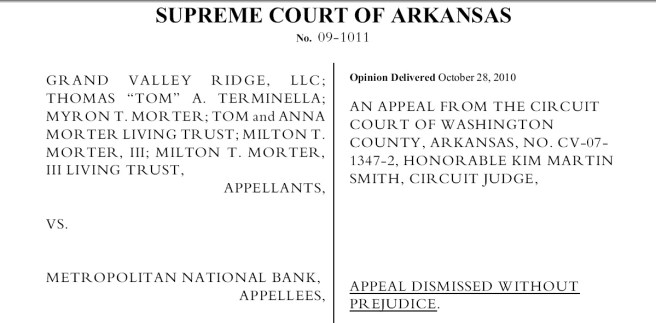
Appeal Dismissed Without PrejudiceOver the past several years, “APPEAL DISMISSED WITHOUT PREJUDICE” has been a recurring disposition in opinions handed down by the Arkansas Supreme Court and the Arkansas Court of Appeals in cases where the order being appealed from was not final and failed to contain a Rule 54(b) certificate. See, e.g., Grand Valley Ridge, LLC v. Metropolitan National Bank, 2010 Ark. 402.

Arkansas Rule of Civil Procedure 54(b) deals with the finality of orders when there are judgments relating to multiple claims or involving multiple parties.  Where there has not been a final judgment with respect to all claims and all parties involved in a particular case, then an appeal from an otherwise non-appealable interlocutory order is improper unless it contains a proper Rule 54(b) certificate.

The relevant portion of Rule 54(b) provides:

(1)  Certification of Final Judgment. When more than one claim for relief is presented in an action, whether as a claim, counterclaim, cross-claim, or third party claim, or when multiple parties are involved, the court may direct the entry of a final judgment as to one or more but fewer than all of the claims or parties only upon an express determination, supported by specific factual findings, that there is no just reason for delay and upon an express direction for the entry of judgment.

Ark. R. Civ. P. 54(b) (2010).

The Rule 54(b) Certificate

Rule 54(b) also provides that when the circuit court finds that an otherwise non-final order should be immediately appealable, the circuit court is required to include the following certificate within the order, immediately after the court’s signature on the judgment.  That certificate is required to set forth the factual findings upon which the determination to enter the judgment as final is based.  Rule 54(b) sets out the language to be included in the certificate as follows:

Rule 54(b) Certificate

With respect to the issues determined by the above judgment, the court finds:

[Set forth specific factual findings.]

Upon the basis of the foregoing factual findings, the court hereby certifies, in accordance with Rule 54(b)(1), Ark. R. Civ. P., that it has determined that there is no just reason for delay of the entry of a final judgment and that the court has and does hereby direct that the judgment shall be a final judgment for all purposes.

Certified this ________ day of ________, ________.

_________________________________________
Judge

Ark. R. Civ. P. 54(b) (2010).

As shown above, Rule 54(b) includes the language that is to be included to transform what would normally be an uappealable interlocutory order into an order from which a party can properly appeal prior to a ruling by the circuit court that pertains to all claims and/or all parties.  However, it is worth noting that “merely tracking the language of Rule 54(b) will not suffice; the record must show facts to support the conclusion that there is likelihood of hardship or injustice that would be alleviated by an immediate appeal rather than at the conclusion of the case.” Bank of Arkansas v. First Union National Bank, Ark. (00-1113) (Nov. 16, 2000).

Appeals are also frequently dismissed without prejudice due to the circuit court’s failure to include within the Rule 54(b) certificate the specific specific factual findings upon which a decision to enter a final judgment was based. See, e.g., Kowalski v. Rose Drugs, 2009 Ark. 524.

Failure to Include 54(b) Certificate in an Otherwise Non-Final Order

When the Rule 54(b) certificate is not attached to an order that is otherwise non-final, that order is not appealable.  Appellate courts simply do not have subject-matter jurisdiction to consider the merits of an appeal where the order being appealed from is not final.  See Zolliecoffer v. Mike Beebe, 2010 Ark. 329; see also Ark. R. App. P. – Civil 2(a)(1). Because the lack of finality creates a jurisdictional problem, that issue is frequently raised by the appellate courts sua sponte. See Grand Valley, supraSuch appeals are dismissed without prejudice.  Once the issue of the non-final order has been dealt with below (by dismissing claims and/or parties or by obtaining an order with a proper Rule 54(b) certificate), then a valid Notice of Appeal can be filed and the appeal can properly be brought before the appropriate appellate court (assuming no other procedural impediments affecting jurisdiction exist).

In Grand Valley, which was handed down by the Arkansas Supreme Court last month, there was no Rule 54(b) certificate within the otherwise non-final order.  The order in that case was not final because it did not resolve all the claims that had originally been raised by Grand Valley and Terminella.  Those parties had filed a motion to voluntary nonsuit without prejudice claims for negligence and interference-with-business-expectancies.  The circuit court granted that motion, rendering the order that was subsequently entered in that case non-final and, therefore, not appealable.

The following are examples of cases where orders were held to be non-final and, therefore, non-appealable absent a Rule 54(b) certificate:

  • Voluntary nonsuit of claims–An order that is final with respect to some claims but where other claims were previously dismissed without prujudice (via a voluntary nonsuit) is not final for purposes of Rule 54(b).  See, Grand Valley Ridge, supra.
  • Claims dismissed as to some parties and transferred  as to othersAn order where the claims against one defendant were dismissed and the claims against another defendant were transferred to another court. See Zolliecoffer, supra; see also Downen v. Redd, 367 Ark. 551 (2006) (holding that an order dismissing claims as to two defendants and transferring the claim as to a third defendant to another circuit court was not final for purposes of Rule 54(b)).
  • Conditional ordersAs a general rule, a conditional order, becoming final upon contingencies, which may or may not occur, is not a final appealable order. See Coleman v. Regions Bank (Case No. 04-750) (Ark. Nov. 3, 2005).
  • Unresolved claims against multiple partiesAn order granting summary judgment in favor of only on defendant in a case where there are multiple defendants is not a final and appealable order unless it contains a proper Rule 54(b) certificate. See Chapman v. Wal-Mart, 351 Ark. 1 (2002).

Rule Change: Appellants Now Required to Abandon Stray Claims in Notice of Appeal

Effective July 1, 2010 Arkansas Rule of Appellate Procedure-Civil 3(e)(vi) requires a notice of appeal to state, among other things, that “the appealing party abandons any pending but unresolved claim.”  The new rule causes the abandonment of any unresolved claims in the notice of appeal to operate as a dismissal with prejudice of any stray claims in a case where the order being appealed from would otherwise be final.

The comments to the rule change further explain its purpose:

This amendment will cure a recurring finality problem. Too often—after the parties have paid for the record, filed it, and filed all their briefs on appeal—the appellate court will discover that what appears to be a final order or judgment is not final because a pleaded claim, counterclaim, or cross-claim remains unadjudicated. This kind of stray claim destroys finality and renders an otherwise final order or judgment unappealable. E.g., Ramsey v. Beverly Enters., Inc., 375 Ark. 424, 291 S.W.3d 185 (2009); Rigsby v. Rigsby, 340 Ark. 544, 11 S.W.3d 551 (2000); Brasfield v. Murray, 96 Ark. App. 207, 239 S.W.3d 551 (2006). These stray claims often appear to have been forgotten by the parties or abandoned even though no order resolved them. It wastes parties’ and courts’ scarce resources to have two appeals in these situations.

A party taking an interlocutory appeal or cross-appeal authorized by the Arkansas Rules of Appellate Procedure, the Rules of the Supreme Court and Court of Appeals, or precedent, should not make this statement in the parties’ notice. Nor is this statement required in a notice of appeal or cross-appeal from a judgment certified by the circuit court as final under Rule of Civil Procedure 54(b). In all these situations, which are in essence interlocutory appeals, some claims remain pending and viable in the circuit court during the appeal.

Ark. R. App. P. – Civil 3 (Addition to Reporter’s Notes, 2010 Amendment).

These comments don’t address what happens where the party who did not bring the lingering claims (usually the defendant) is the party appealing from the non-final order.  Presumably a defendant who chooses to appeal from a non-final order could not abandon claims that were originally brought by the plaintiff.  It seems that in those situations, the defendant should obtain a Rule 54(b) certificate in order to appeal from an otherwise non-final order.

It is also worth noting that this statement doesn’t help cure finality problems deriving from the failure to obtain a final order with respect to all parties.  A prior change to Rule 54 alleviates that problem with respect to John Doe defendants who were named in the lawsuit but who were never known and, thus, never served during the litigation.  Effective January 1, 2009, the Arkansas Supreme Court amended Rule 54 to provide that “[a]ny claim against a named but unserved defendant, including a ‘John Doe’ defendant, is dismissed by the circuit court’s final judgment or decree.” Ark. R. Civ. P. 54(b)(5); see Jackson v. Sparks Regional Medical Center, 375 Ark. 533 (2009) (holding that Rule 54(b)(5) could be applied retroactively).

UPDATED: Arkansas Supreme Court: West Memphis 3 Cases Reversed and Remanded

West Memphis 3 Cases Reversed and Remanded

“Therefore, we reverse and remand for an evidentiary hearing and reconsideration of the motion in light of the proper interpretation of the statutes.”

Echols v. State, 2010 Ark. 417, at 16.

The Arkansas Supreme Court handed down opinions this morning in the West Memphis 3 cases.  The Court reversed all three cases and remanded for evidentiary hearings to be held in accordance with the proper interpretation of the relevant statutes. 

Here are links to the opinions:

The Echols case was argued to the Arkansas Supreme Court on September 30, 2010.  Click here to view the video of the oral argument.

News Coverage of Today’s Opinions:

UPDATED News Stories:

Video Links:

UPDATE: Arkansas Supreme Court Election Results: Judge Karen Baker Wins Election for Position 6

With 78% of the precincts reporting, the Arkansas Democrat Gazette has called the election for Position 6 on the Arkansas Supreme Court for Judge Karen Baker.  Judge Baker led by a slim margin early in the night, but took a bigger lead as the night continued.  The race in Pulaski County (Judge Fox’s home county) was close, with Judge Baker edging out Judge Fox 51% to 49%.  In Judge Baker’s home county (Van Buren County), Judge Baker defeated Judge Fox by 73% to 27%.  As of the time this post was published, Judge Fox had won or was leading in the following counties: Ashley, Perry, Polk, Prairie. and Sevier.  Several other counties had not yet reported results.

Judge Karen Baker currently serves as the Court of Appeals Judge for District 2, Position 2.  She was elected to that position in 2000 and re-elected in 2004 (Act 1812 of 2003 reapportioned the Court of Appeals districts and required a new election for this position in 2004).  Judge Baker’s eight-year term on the Court of Appeals will end in 2012.  It is expected that Governor Mike Beebe will appoint a replacement for the vacancy that will be created when Judge Baker takes office as an Associate Justice on the Arkansas Supreme Court in January, 2011.

Judge Tim Fox was elected to serve as a Pulaski County Circuit Court judge in 2002 and then re-elected to another six-year term in 2008.

UPDATE: As of 6:00 p.m. on November 3, 2010, 98% of precincts are reporting the following results in the Supreme Court Election:  Baker 388,530 (61%), Fox 252,639 (39%).