A notice issued today by the Administrative Office of the Courts provides that although seating will be limited in the courtroom itself, there will be an overflow room set up at the Justice Building to accommodate those who wish to attend the argument in person and who are unable to get a seat in the courtroom. The notice also reminds the public that the arguments can be viewed live online through the Court’s new video feed of oral arguments.
Today’s notice also provides that on September 30, 2010, the Justice Building will be open at 7:30 a.m. and seating will be on a first-come, first-served basis, with only 15 seats reserved for the media. The following rules will be enforced for those in attendance at the September 30th oral argument:
Everyone who enters the building must go through security.
No signs, shirts, buttons, or other displays in support of or against any party in this case or related cases will be allowed (anyone wishing to hold signs or other information must do so outside, although the streets, sidewalks, and entrances must remain unobstructed).
No weapons of any kind will be permitted.
No cameras or recording devices will be permitted in the courtroom.
No umbrellas allowed.
No buttons, shirts, or signs supporting any party involved in a case will be permitted.
No campaign material permitted.
Phones must be turned off in the courtroom.
The William H. Bowen School of Law plans to stream the arguments in the Echols case in the Friday Courtroom on September 30, 2010. The law school’s event will be open to the public.
UPDATE: On November 4, 2010, the Arkansas Supreme Court handed down its opinion in the West Memphis 3 cases. The Court reversed and remanded for an evidentiary hearing and reconsideration of the motion in light of the proper interpretation of the statutes. See Arkansas Supreme Court: West Memphis 3 Cases Reversed and Remanded.
United States Court of Appeals for the Eighth Circuit
The rules of appellate practice are changing for appellate attorneys who practice in front of the United States Court of Appeals for the Eighth Circuit. Beginning October 1, 2010, the Eighth Circuit will require that all appellate briefs be filed electronically.
Authored by Jess Askew III of Williams & Anderson, The Arkansas Appellate Cycle Blog combines information about appellate practice and procedure with Mr. Askew’s more than twenty years of experience as an appellate attorney in Arkansas. In his blog posts, Mr. Askew creatively weaves his love for cycling with his passion for appellate practice to provide a helpful frame of reference outside of the law that often helps him explain legal minutiae. Mr. Askew describes his goal with the blog as follows:
My goal is to have a conversation about appellate practice in the state courts of Arkansas, and the cycling perspective can help make a point or two along the way. There is also the natural metaphor between the journey of a bike trip and the life of a lawsuit, from trial through appeal. I hope the cycling perspective will make this blog more accessible and enjoyable.
Check out Mr. Askew’s most recent blog post entitled Final Orders & The Addendum for an example of how he creatively connects the cycling process to Arkansas’s appellate cycle.
Mr. Askew’s resume as an appellate practitioner is impressive. He began his legal career as a law clerk to the late Richard S. Arnold, who sat as a judge and later as Chief Judge on the United States Court of Appeals for the Eighth Circuit. Mr. Askew has been involved in numerous cases on appeal, including the recent cases of Arkansas Blue Cross v. Little Rock Cardiology Clinic, 551 F. 3d 812 (2009), dealing with federal ancillary jurisdiction in a health-care case; Arkansas Democrat-Gazette v. District Court, Ark. S. Ct. No. 08-1435 (Dec. 18, 2008), establishing the availability of a writ of certiorari from a circuit court to an inferior court under Amendment 80 to the Arkansas Constitution; and Cox v. Daniels, 374 Ark. 437 (2008), rejecting a ballot-title challenge to the Arkansas College Scholarship Lottery Amendment under Amendment 7 to the Arkansas Constitution. Additionally, Mr. Askew was a contributor to the Arkansas Bar Association’s treatise on Handling Appeals in Arkansas. Mr. Askew is listed in Best Lawyers in America under appeallate practice.
The experience and knowledge Mr. Askew brings to The Arkansas Appellate Cycle Blog makes it a great new resource for Arkansas appellate lawyers. To follow the blog, click on the links provided in this post or click on the link to The Arkansas Appellate Cycle Blog in our list of Blog Links included in the sidebar to the right.
Tune in on your computer this morning to become part of Arkansas history as the Arkansas Supreme Court launches its live video feed of oral arguments at 9:00 a.m., CST.
Two cases are set for oral argument this morning. Click here to view Arkansas appellate attorneys present arguments to the Arkansas Supreme Court in the following cases:
In case you missed it, Associate Justice Robert L. Brown of the Arkansas Supreme Court wrote a guest editorial in today’s Arkansas Democrat Gazette entitled New Day in Court. In his editorial, Justice Brown discusses the Arkansas Supreme Court’s decision to embrace technology by streaming its oral arguments of appellate court cases live on the Internet. He also shares his opinion concerning the United State Supreme Court’s refusal to embrace the same technology and his hope that it soon will:
Three years ago, I wrote an article that was critical of the United States Supreme Court for not following the leads of the state supreme courts in providing live video telecasts of oral arguments. Sadly, though, it still has not moved in the direction of these state supreme courts and refuses to record video of its oral arguments, either for live or delayed broadcasts. My personal opinion is that this recalcitrance on the part of the court denies the people of this country a critically important benefit. What could be more educational than making these arguments available?
Despite this reluctance, there are hopeful signs that the court may change. Justice Elena Kagan said in her confirmation hearings this summer that she supported live broadcasts while quipping that this would mean more hair appointments for her. Justice Ruth Bader Ginsberg is also receptive to the idea, as may be Justices Stephen Breyer, Samuel Alito and Sonia Sotomayor.
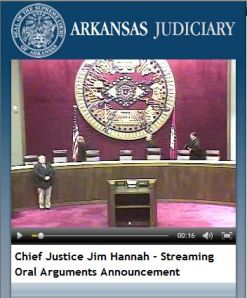
This morning, we attended the Arkansas Supreme Court’s press conference announcing that live streaming videos of oral arguments presented in Arkansas’s appellate courts will be available beginning this week. Governor Mike Beebe was in attendance at the Court’s press conference along with members of the Arkansas Court of Appeals, Arkansas Bar Association President Jim Julian, members of the Arkansas bar, a representative from AETN, and staff members from the courts. Rather than make the announcement in person, Chief Justice Hannah and the other justices made the announcement via live streaming video from the courtroom, which was broadcast to a conference room in the Justice Building. (The justices later visited the conference room to make additional comments.) Below you will find a short video of the first minute or so of that press conference.
This Thursday marks the first day that the Arkansas Supreme Court will stream its oral arguments live to the Internet. Chief Justice Hannah described this as “an historic moment for Arkansas,” and an example of the Court’s committment to “providing greater access to justice and to facilitating a better understanding of the judiciary.”
While acknowledging that courts seldom welcome change, Chief Justice Hannah noted the monumental ways in which our Arkansas Supreme Court has been moving forward and embracing technological advances at a faster rate than other state appellate courts. Last year, Arkansas became the first state in the country to designate its electronic record as the official opinion of the court, a decision which saves Arkansas around $300,000 in publication costs each year. Other states and the federal judiciary are now looking to Arkansas as the leader on this front. With today’s announcement, Arkansas joins only half of state appellate courts in the nation offering a live broadcast of oral arguments, and Arkansas joins only fifteen states that allow their videos of oral arguments to be archived online. AETN is developing plans to broadcast the oral arguments as well.
Click above to view this morning's full video announcement from the Arkansas Supreme Court about live video streaming of oral arguments on the Internet.
The use of cameras in the courtroom has been a topic of discussion among members of the Court for the past several years. In the Spring of 2007, Associate Justice Robert L. Brown of the Arkansas Supreme Court wrote an article that was published in The Journal of Appellate Practice and Process entitled Just a Matter of Time? Video Cameras at the United States Supreme Court and the State Supreme Courts. In his article, Justice Brown discussed arguments for and against the use of cameras in appellate courts. The pros include more transparency in government, public education, and an increase in understanding of and respect for the judicial process. The cons include potential grandstanding by attorneys or justices, the possibility of unfavorable video clips being taken out of context by the media (in states where appellate judges are elected) or by political opponents, and problems with open microphones (where justices’ comments between oral arguments are picked up and potentially broadcast by the court’s sound system).
Justice Brown is no doubt an ardent supporter behind the Arkansas Supreme Court’s decision to permit live broadcasts of oral arguments in Arkansas’s appellate courts. In fact, Justice Brown has long argued that the United States Supreme Court should adopt a similar policy of permitting cameras in the courtroom. Following Chief Justice Hannah’s remarks this morning, Justice Brown called on the Supreme Court of the United States to follow the lead of Arkansas, arguing that “it’s time, I believe, for the United States Supreme Court also to either broadcast, or televise, or webcast their oral arguments.” Justice Brown is hopeful that this might soon happen with the entrance of Justice Sonia M. Sotomayor and Justice Elena Kagan to the Court.
While this is certainly a big day for Arkansas appellate courts and Arkansas appellate attorneys, it probably goes without saying that the thought that anyone in the world could be watching their oral arguments will keep appellate attorneys on their toes!
The Administrative Office of the Courts (AOC), pursuant to its authority under Administrative Order 21, took a step toward implementing electronic filing statewide when it recently announced its request for proposals “for systems and services for the implementation of a comprehensive statewide electronic filing system for the Arkansas Judiciary.” According to the AOC, the filing system must meet the following requirements:
The system must have the proven capability of handling all types of cases including small claims, traffic, criminal, civil, probate, juvenile, and domestic relations. The system must also have been successfully implemented at limited, general, and appellate levels of a multi-jurisdictional court system.
Arkansas appellate attorneys and Arkansas general practitoners would benefit from the type of uniform statewide filing system, as described by the AOC.
The Arkansas Court of Appeals met this week for its end of summer motions conference. The results are included in the Court’s August 25, 2010 Syllabus.
The summer recess for Arkansas’s appellate courts will soon be over, as both courts begin their fall terms within the next couple of weeks. The courts will hear their first oral arguments of the fall term on September 15, 2010 (Court of Appeals), and September 16, 2010 (Supreme Court).


 ArkansasAppeals.com