
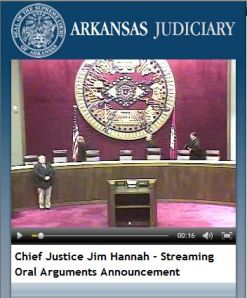
This morning, we attended the Arkansas Supreme Court’s press conference announcing that live streaming videos of oral arguments presented in Arkansas’s appellate courts will be available beginning this week. Governor Mike Beebe was in attendance at the Court’s press conference along with members of the Arkansas Court of Appeals, Arkansas Bar Association President Jim Julian, members of the Arkansas bar, a representative from AETN, and staff members from the courts. Rather than make the announcement in person, Chief Justice Hannah and the other justices made the announcement via live streaming video from the courtroom, which was broadcast to a conference room in the Justice Building. (The justices later visited the conference room to make additional comments.) Below you will find a short video of the first minute or so of that press conference.
This Thursday marks the first day that the Arkansas Supreme Court will stream its oral arguments live to the Internet. Chief Justice Hannah described this as “an historic moment for Arkansas,” and an example of the Court’s committment to “providing greater access to justice and to facilitating a better understanding of the judiciary.”
While acknowledging that courts seldom welcome change, Chief Justice Hannah noted the monumental ways in which our Arkansas Supreme Court has been moving forward and embracing technological advances at a faster rate than other state appellate courts. Last year, Arkansas became the first state in the country to designate its electronic record as the official opinion of the court, a decision which saves Arkansas around $300,000 in publication costs each year. Other states and the federal judiciary are now looking to Arkansas as the leader on this front. With today’s announcement, Arkansas joins only half of state appellate courts in the nation offering a live broadcast of oral arguments, and Arkansas joins only fifteen states that allow their videos of oral arguments to be archived online. AETN is developing plans to broadcast the oral arguments as well.
The final stage in the Court’s efforts to embrace technology is eventually to make all pleadings available online, a project that is currently underway. In fact, the Administrative Office of the Courts recently announced its request for proposals for a vendor to develop such a system.
The use of cameras in the courtroom has been a topic of discussion among members of the Court for the past several years. In the Spring of 2007, Associate Justice Robert L. Brown of the Arkansas Supreme Court wrote an article that was published in The Journal of Appellate Practice and Process entitled Just a Matter of Time? Video Cameras at the United States Supreme Court and the State Supreme Courts. In his article, Justice Brown discussed arguments for and against the use of cameras in appellate courts. The pros include more transparency in government, public education, and an increase in understanding of and respect for the judicial process. The cons include potential grandstanding by attorneys or justices, the possibility of unfavorable video clips being taken out of context by the media (in states where appellate judges are elected) or by political opponents, and problems with open microphones (where justices’ comments between oral arguments are picked up and potentially broadcast by the court’s sound system).
Justice Brown is no doubt an ardent supporter behind the Arkansas Supreme Court’s decision to permit live broadcasts of oral arguments in Arkansas’s appellate courts. In fact, Justice Brown has long argued that the United States Supreme Court should adopt a similar policy of permitting cameras in the courtroom. Following Chief Justice Hannah’s remarks this morning, Justice Brown called on the Supreme Court of the United States to follow the lead of Arkansas, arguing that “it’s time, I believe, for the United States Supreme Court also to either broadcast, or televise, or webcast their oral arguments.” Justice Brown is hopeful that this might soon happen with the entrance of Justice Sonia M. Sotomayor and Justice Elena Kagan to the Court.
While this is certainly a big day for Arkansas appellate courts and Arkansas appellate attorneys, it probably goes without saying that the thought that anyone in the world could be watching their oral arguments will keep appellate attorneys on their toes!
For more information about the Supreme Court’s rule permitting cameras to be used in appellate court proceedings, visit our previous blog post entitled Arkansas Supreme Court Permits Cameras in Appellate Proceedings.
To view other news stories on this topic, click on the following links:
 ArkansasAppeals.com