
Hallelujah! (In other words, the Arkansas Supreme Court is abolishing the abstract and addendum requirement.)

Arkansas Justice Building--Home of the Arkansas Supreme Court and Arkansas Court of Appeals

As we noted in our original post (below), the Arkansas Supreme Court has proposed a set of rule changes that abolish the abstracting and addendum requirement.  In the original post, we promised to provide updates and more details, so we’re doing that now. Before delving into those details, please note that these are proposed revisions, so they are subject to change.  However, if you can get your record in electronic format, you may participate in a pilot project using these rules.  So, with that said, here are the major changes (and, of course, review the per curiam before filing your brief; this is just a general overview):

The Biggest Change: Abolition of the Abstracting and Addendum Requirement

This, of course, is the biggest change.  Attorneys are no longer required to prepare an abstract or an addendum.  Rather, attorneys will refer to the relevant page number in the record.  As mentioned below, the record will now be comprised of two separate portions: a pleading portion and a transcript portion.  If you cite to the pleading portion of the record, use the format (RP 10), and if you cite to the transcript portion, use the format (RT 10).  The court has a computer program that converts those citations to links to the relevant portion of the record.

Preparation and Filing of the Record

As mentioned above, there will now be two portions of the record: pleadings and transcripts.  The record must be in electronic format (PDF), and each portion of the record must be sequentially numbered such that the first page of the PDF is the first page of the record.  This means that whatever the first page of the PDF is (cover page, table of contents, etc.), it must be page 1.Under the proposed rule, attorneys are still responsible for filing the record, but unlike in the past, the record can now be filed electronically.  

Brief Components

In addition to the elimination of the abstract and addendum, the informational statement (the form that included questions about the appeal and the brief) has been eliminated.  The jurisdictional statement has more specific requirements under the proposed rule than under the current rule.  There are also a couple of new sections: a request for relief and a certificate of compliance with Administrative Order No. 19 (relating to confidential information) and with the word-count limitations (discussed in more detail below).  Finally, the “statement of the case” has been replaced with the “statement of the case and facts.”  

Length Limitations

There are two significant changes to the length of the brief.  First, rather than limiting the statement of the case to a certain number of pages and the argument to a certain number of pages, the limitation is a global limitation that can be allocated in whatever way makes the most sense.  Second, the limitation is converted to a word limit, rather than a page limit. The word count includes the jurisdictional statement, the statement of the case and the facts, the argument, and the request for relief. All other portions of the brief are disregarded for purposes of the word count. Here are the limits:

Brief TypeWord Count Limit
Appellant’s Brief8,600
Appellee’s Brief8,600
Reply Brief2,875
Appellee’s/Cross-Appellant’s Brief14,325
Reply/Cross-Appellee’s Brief11,475


ORIGINAL POST

As Justice Rhonda Wood described it on Twitter, there was some “HUGE” news from the Arkansas Supreme Court this morning:

Arkansas Supreme Court

We’re still reading the per curiam, and it’s full of changes, 

but here’s a brief synopsis (you can expect a more detailed examination later).


First, effective immediately, attorneys may begin requesting electronic records from the circuit clerk, and the circuit clerk is required to provide the record in electronic format.

Second, the Arkansas Supreme Court published for comment revisions to the rules that accommodate these electronic records.  Those rules abolish the requirements of an abstract and addendum.  

Third—and here’s the best part—even though those rules are currently only published for comment (meaning they are not in effect yet), attorneys who choose to file their records electronically are permitted to file under the new rules as part of a pilot project.

As the Supreme Court noted in its per curiam, the abstracting requirement (and, to a lesser extent, the addendum requirement) had outlived their usefulness.  In our opinion, the abstract adds needless time and expense (both in attorney’s fees and printing costs) to the appellate process, it is confusing, and even a well-done abstract can’t effectively capture what occurred at trial.  This is a good move, and we look forward to seeing it fully implemented.  And you can rest assured that we will never order another paper record again!

Amendment to Ark. Sup. Ct. R. 4-2(b) Gives Appellate Court Option to Avoid Rebriefing When Appellant’s Abstract or Addendum is Deficient

The Arkansas Supreme Court recently amended Arkansas Supreme Court Rule 4-2, which governs contents of briefs on appeal, to give appellate courts an additional option concerning how those courts may handle deficiencies in the appellant’s abstract or addendum. See In Re 4-2(b) of the Rules of the Supreme Court and Court of Appeals, 2011 Ark. 141.  With the recent amendment to Rule 4-2(b), when the Arkansas Supreme Court or the Arkansas Court of Appeals determines that deficiencies in an appellant’s abstract or addendum need to be corrected, but rebriefing is not necessary, the court may order the appellant to file a supplemental abstract or addendum.  If an appellate court allows a supplemental abstract or addendum to be filed, that must be done within 7 calendar days.  This amendment to Rule 4-2(b) became effective March 31, 2011. See In Re 4-2(b) of the Rules of the Supreme Court and Court of Appeals, 2011 Ark. 141

It appears that this amendment to Rule 4-2(b) will have the effect of allowing the appellate courts, in their discretion, to more quickly and efficiently obtain information that was missing from the appellant’s abstract or addendum rather than always requiring rebriefing in those situations.  Where an appellant’s abstract or addendum is deficient or where important documents were omitted, that appellant (or his or her attorney) will save the additional cost of reprinting the entire brief in cases where the appellate court determines that rebriefing is not necessary. 

The Arkansas Supreme Court’s amendment to Rule 4-2(b) reads as follows:

(b) Insufficiency of appellant’s abstract or addendum. Motions to dismiss the appeal for insufficiency of appellant’s abstract or addendum will not be recognized. Deficiencies in the appellant’s abstract or addendum will ordinarily come to the court’s attention and be handled in one of four ways as follows:

. . .

(4) If the appellate court determines that deficiencies or omissions in the abstract or addendum need to be corrected, but complete rebriefing is not needed, then the court will order the appellant to file a supplemental abstract or addendum within seven calendar days to provide the additional materials from the record to the members of the appellate court.Ark

Ark. Sup. Ct. R. 4-2(b)(4).

Judge Posner, the Blue Book, and Arkansas Citation Resources

Judge Richard Posner, of the U.S. Court of Appeals for the Seventh Circuit, created quite a stir lately with his law review article in the Yale Law Journal, in which he criticized the Blue Book’s citation format.  Though his article criticizes many aspects of the Blue Book (its size, for example), he is particularly critical of its system of abbreviation:

An example that I have picked literally at random is “C.Ag.” What does “C.Ag.” stand for? Why, of course, the Código de Águas of Brazil. Now suppose one had occasion to cite the Código de Águas. Why would one want to abbreviate it? The abbreviation would be meaningless to someone who was not a Brazilian lawyer, and perhaps to Brazilian lawyers as well (but do  they abbreviate  Código de Águas “C.Ag”?).  The basic rule of abbreviating, ignored by the authors of The Bluebook, is to avoid nonobvious abbreviations: don’t make the reader puzzle over an abbreviation, as  The Bluebook does routinely. Consider “Temp. Envtl. L. & Tech. J.,” “ILSA J. Int’l & Comp. L.,” “Emp. Rts. & Emp. Pol’y J.,” and “AIPLA Q.J.” These are names of journals. Now try figuring out “B.T.A.M. (P-H),” “A. Ct. Crim. App.,” “A.F. Ct. Crim. App.,” “C.G. Ct. Crim. App.,” “N-M  Ct. Crim. App.,” “Ne. Reg’l Parole Comm’n,” and “Cent. Ill. Pub. Serv. Co.” What is the point? It’s as if there were a heavy tax  on letters, making it costly to write out Coast Guard Court of Criminal Appeals instead of abbreviating it “C.G. Ct. Crim. App.”

Judge Posner is so dissatisfied with The Bluebook that he has drafted his own citation manual, which is used by the clerks who assist him in drafting his opinions.  The manual is approximately three pages long (or, in Judge Posner’s words, “one one-hundredth  the length of  The Bluebook”).

While Arkansas appellate attorneys might not want to rely on Judge Posner’s 3-page manual when drafting appellate briefs in Arkansas, there are resources available to Arkansas attorneys (in addition to the Blue Book) that can assist with proper citation in appellate court briefs.  The website of the Arkansas Reporter of Decisions provides several of these resources: 

  • The House Style Guide–One of the most helpful resources provided by the Reporter of Decisions is the House Style Guide, which is the style guide used by the Arkansas appellate court judges and their law clerks when drafting opinions.  The House Style Guide provides information on Arkansas citations as well as punctuation, word usage, possessives, and other grammar and stylistic conventions used by Arkansas’s appellate courts.
  • Citations Guidelines–For a brief overview of citations to opinions of the Arkansas Supreme Court and Arkansas Court of Appeals, the Citations Guidelines page is also helpful.  
  • Citations Page–the Citations Page provides more detailed citation examples, including examples of citations to opinions of appellate courts of all 50 states, along with various rules, law reviews, and other materials.

For more information about how use the new citation format in Arkansas pursuant to Arkansas Supreme Court Rule 5-2(d)(2), check out our previous blog post on the topic, Using Arkansas’s New Citation Format.

If you want even more information about using citations in Arkansas trial court and appellate court briefs, the UALR William H. Bowen School of Law will be hosting a free CLE on Monday, March 7 at 11:30.  The CLE, entitled Citation Insights: The Bluebook, the ALWD Citation Manual, and the Arkansas Supreme Court’s Citation Rules and Practices, will be presented by Professor Coleen Barger.  Attorneys who attend can receive 1 hour of CLE credit.  There is no charge for the CLE, but there is a $5 charge for lunch.  If you plan to attend, please email Haley Walker at hewalker@ualr.edu.

Related Posts:

Arkansas Court of Appeals Orders Rebriefing in Two Cases; Warns Appellate Attorneys of Pitfalls of Not Strictly Adhering to Rules

The Arkansas Court of Appeals ordered rebriefing today in the following two cases:

  1. In Fowler v. State, 2010 Ark. App. 811, the Arkansas Court of Appeals ordered rebriefing because a portion of the judgment was excluded from the addendum.
  2. In Snyder v. State, 2010 Ark. App. 817, the Arkansas Court of Appeals ordered rebriefing because petitions for revocation were not included in the addendum.

Concurring in the Fowler decision, Judge David M. Glover wrote separately to “emphasize our supreme court’s mandated consequences of noncompliance with our appellate briefing rules.”  For attorneys who engage in appellate practice in Arkansas, Judge Glover’s opinion is a reminder that “you can only play the game by the rules.”  He warns appellate attorneys to be careful when filing appellate briefs in Arkansas’s appellate courts:

Arkansas Supreme Court Rule 4-2(a)(8) (2008) is the fulcrum for both of our rebriefing orders. Our supreme court, in City of Cotter, 2009 Ark. 172, by per curiam order, enunciated the bright-line rule to which our panel today respectfully adheres. It really does not matter that in that case, Justice Brown, in dissent, finding that the court had become far too strict in its application of the abstract rule, stated, “We have crafted yet another procedural pitfall for the appellate lawyer, which in my judgment is largely unnecessary.” Quite simply, the rule must be followed.

Twenty years ago, United States Magistrate Judge Jerry W. Cavaneau (Recalled) referenced that lawyers love to talk about “pitfalls for the unwary” in an article addressing Rule 54(b) of the Arkansas Rules of Civil Procedure.  When abstracting for the Arkansas appellate courts, copier jams, basic oversights, and not adhering to the rules can be such pitfalls. I did not make the rules, but I know you can only play the game by the rules. Our rules are found in our Court Rules – Volumes 1 and 2. You really have to be careful out there, and wary. 

Fowler v. State, 2010 Ark. App. 811, at 2–3 (Glover, J., concurring) (emphasis added) (footnotes omitted).

In an attempt to put an end to the growing number of deficient briefs it had been receiving, the Arkansas Supreme Court amended Arkansas Supreme Court Rule 4-2 just last year.  Among other things, that amendment was meant to provide appellate attorneys in Arkansas with more guidance concerning the contents of the appellant’s addendum. See Arkansas Supreme Court Proposes Rule Changes as Possible Solution to Brief Deficiencies.  The amended version of Rule 4-2 went into effect on January 1, 2010

For more on this topic, view our previous posts:

Using Arkansas’s New Citation Format (Ark. Sup. Ct. R. 5-2(d)(2))

Arkansas’s New Electronic Database of Opinions

In May of 2009, the Arkansas Supreme Court handed down a per curiam decision that made Arkansas the first state in the nation to publish its official reports in electronic format only. See  Rule 5-2 Rewritten: (1) Arkansas Becomes First State with Electronic Official Reports; (2) Court Abandons Use of “Unpublished” Decisions.  The Court ordered that the official report of decisions issued after February 14, 2009, “shall be an electronic file created, authenticated, secured, and maintained by the Reporter of Decisions on the Arkansas Judiciary website.” Ark. Sup. Ct. R. 5-2(b)(1).

Arkansas’s New Citation Format

Along with its decision to publish opinions handed down after July 1, 2009 in an electronic-only format, the Court also implemented a new citation rule for those electronically published decisions. See Ark. Sup. Ct. R. 5-2(d)(2).

As shown in the chart below, Arkansas’s new citation rule for electronically reported decisions is somewhat different from the traditional citation rule for decisions published in the bound volumes of the Arkansas Reports and the Arkansas Appellate Reports.

The new citation format for electronically published decisions permits parallel citations to unofficial sources, including unofficial electronic databases, but only when the regional reporter citation is unavailable. (Parallel citations are highlighted in green in the chart below).  Notice also that, the new citation format omits the parenthetical with the year the case was issued because the year is now the first number in the citation.

Additionally, the new citation rule requires a different format for pinpoint citations.  Arkansas Supreme Court Rule 5-2(d) strongly encourages the use of pinpoint citations for citations to all Arkansas opinions.  The use of pinpoint citations with the new citation format differs from the traditional citation format in two respects. (Pinpoint citations are highlighted in yellow in the chart below).

First, the use of pinpoint citations with the new format always requires the use of the word “at.”  When citing to cases that are published in the printed version of the Arkansas Reports, the traditional citation rule requires the use of the word “at” only when using short cites, and never when using full citations of a case.

Second, the pinpoint citation will always refer to the page of the opinion itself rather than a page in a published reporter.  Unlike opinions published in the Arkansas Reports, every opinion published electronically begins with page 1.  Providing the correct pinpoint citation under the new citation format now requires attorneys to find the decision online and then refer to the specific page of that decision where the information being cited is found. 

The following chart, based on Arkansas Supreme Court Rule 5-2(d), illustrates the differences between the traditional citation format and the new citation format:

Citing to Arkansas Opinions (Rule 5-2(d))

Locating Page Numbers for Pinpoint Citations to Arkansas’s Electronically Reported Decisions

The Arkansas Judiciary Website

Arkansas’s electronically reported decisions can be found on the Arkansas Judiciary website.  Although not as powerful as the search tools provided by electronic legal research databases such as Westlaw, LexisNexis, and fastcase, a search tool is available on the Arkansas Judiciary’s website that allows attorneys to search for electronically reported cases handed down by the Arkansas Supreme Court and the Arkansas Court of Appeals.

Electronic Legal Research Databases: Westlaw vs. Fastcase

While the electronically published decisions are available on the Arkansas Judiciary’s website, most appellate attorneys who subscribe to online legal research databases–such as Westlaw and fastcase–will begin their legal research with those tools.  Surprisingly, Westlaw does not seem to provide the page numbers for Arkansas opinions that are available in the electronic-only format.  Fastcase, however, does include the specific page numbers for those decisions.

As an appellate attorney who subscribes to Westlaw Next, I typically begin my legal research with Westlaw.  When I need to cite to a recent Arkansas decision (handed down since February of 2009) in an appellate brief, however, I also now have to find that decision using either the Arkansas Judiciary website or fastcase to find the specific page number to include as a pinpoint citation.

To make sense of all of this, if you are a Westlaw subscriber, then conduct a Westlaw search for the case of W.E. Pender & Sons, Inc. v. Lee, 2010 Ark. 52, 2010 WL 391332, a February 4, 2010 decision of the Arkansas Supreme Court (type “2010 Ark. 52” in your Westlaw search box for this result).  You should notice that Westlaw does not provide the official page numbers for that case–(Although Westlaw sometimes provides star pages, I have not found a recent decision where Westlaw provides official page numbers for that decision).

If you have access to fastcase, now conduct a search for the same case within your fastcase search box, and notice how the material included on each page is clearly labeled by page numbers along the left side of the page (“Page 1,” “Page 2,” etc.).  If you do not subscribe to fastcase, you should know that if you are a member of the Arkansas Bar Association, your membership includes a free subscription to fastcase.  Contact the Arkansas Bar Association for details.

You can also locate the page numbers for this case by finding the pdf file for W.E. Pender & Sons, Inc. on the Arkansas Judiciary website (type “2010 Ark. 52” into the search box).

As a subscriber to Westlaw, I am hopeful that it will eventually catch up with Arkansas’s new electronic opinion format and include page numbers to those opinions so that Arkansas appellate attorneys who subscribe to Westlaw can more easily include pinpoint citations in their appellate briefs.  Until then, Arkansas appellate attorneys who subscribe to Westlaw will be required to access other online tools to find the pinpoint citations for decisions issued in Arkansas’s new electronic format. 

If anyone has had a different experience using Westlaw than what I have described, I would be interested in knowing that—please e-mail me at Tasha@TaylorLawFirm.com to share your experience.  I would also be interested in knowing whether LexisNexis provides page numbers that correlate to those published in the official electronic reports, as we do not subscribe to that database.

The End of an Era: Final Bound Volume of Arkansas Reports Issued

In a press release dated June 28, 2010, the Administrative Office of the Courts announces that the final bound volume of the Arkansas Reports and Arkansas Appellate Reports has been issued.

The final issue of the Arkansas Reports comes one hundred and seventy-three years after its first publication.  Arkansas is the first state in the country to eliminate the use of bound volumes of the appellate courts’ opinions. See Act 221 of 2009.  The final bound volume of the Arkansas Reports includes decisions from November 5, 2008 to February 12, 2009.  All opinions of the Arkansas Supreme Court and Court of Appeals handed down on or after February 14, 2009 are officially published as electronic versions, which can be found on the judiciary’s web site.


Arkansas Supreme Court To Permit Cameras In Appellate Proceedings

Today’s per curiam from the Arkansas Supreme Court–In Re Amendment to Administrative Order No. 6–permits broadcasting, recording, and photography in appellate proceedings in the Arkansas Supreme Court and the Arkansas Court of Appeals.

This big change in the way Arkansas’s appellate courts do business comes with a lengthy set of rules governing the use of cameras in the courtrooms–the following is a summary of some of the highlights from the amendments to Administrative Order Number 6 that govern the use of cameras and electronic devices in all courtrooms across the state:

  • Judges may authorize broadcasting, recording, or photographing in the courtroom and the areas adjacent to the courtroom throughout the proceedings, recesses, etc., as long as the participants will not be distracted and the dignity of the proceedings will not be impaired.With a timely objection, parties or attorneys can preclude broadcasting, recording, or photographing of the proceeding.
  • Witnesses have a right to refuse to be broadcast, recorded, or photographed.
  • Jurors, minors without parental or guardian consent, victims in cases involving sexual offenses, and undercover police agents or informants shall not be broadcast, recorded, or photographed.
  • Juvenile matters, probate matters, and domestic relations matters shall not be subject to broadcasting, recording, or photographing.
  • Judges will retain ultimate control of the application of the rules and their decisions will be final and not subject to appeal.  At any time, the court may determine in its discretion to terminate the broadcast, recording, or photography. 
  • Only two cameras will be permitted in the courtroom during a trial: one camera for still photography and one for video/television photography.  The media will have a pooling arrangement whereby representatives of the news media will share the photography and video footage.  If the court has its own broadcasting, recording, or photography system, the court’s system shall be used, unless the court determines otherwise.
  • Electronic devices cannot be used in courtrooms to broadcast, record, photograph, e-mail, blog, tweet, text, post, or transmit information by any other means except as may be allowed by the court.
  • Oral arguments at the Arkansas Supreme Court and Court of Appeals may be recorded, broadcasted, or webcasted through a live or tape-delayed format as the Supreme Court shall direct.  The Supreme Court’s courtroom is being equipped with a system to record and broadcast oral arguments that the Court plans to implement in the 2010 Fall Term of the Court.  Those recordings will be retained at the Clerk’s office and may be purchased for a cost to be set by the Court to cover the cost of the copies.  Objections to the recording of oral arguments and other appellate proceedings may be made to the Court.

Arkansas Supreme Court Rule 4-2 Requires Appellant’s Addendum To Be “Just Right”

Attention appellate attorneys: recognizing that you might already feel a bit like Goldilocks–somewhat lost while meandering through a forest of rules and requirements to attempt to create the perfect brief–you will probably not feel as comforted as she was to hear the characterization “just right” with respect to creating the perfect appellant’s addendum.  That was the message at the conclusion of yesterday’s decision  in West Memphis Adolescent Residential, LLC v. J.T. Compton, et al., 2010 Ark. App. 450, — S.W.3d — (2010), which includes a notice “[f]or the benefit of the appellate bar” calling appellate attorneys to create addenda that are neither too big nor too small.

The Arkansas Court of Appeals explained that Rule 4-2(a)(8) requires that the documents contained in the appellant’s addendum not be too many or too few.  Rather, an addendum must contain only those documents necessary to an understanding of the issues on appeal or the appellate court’s jurisdiction:

For the benefit of the appellate bar, we note that WMAR has included many unnecessary documents in its addendum, such as multiple copies of the various contracts and leases; motions to dismiss and orders denying the motions; motions and orders on discovery disputes; motions in limine; scheduling orders; orders extending the time to respond to summary judgment motions; and protective orders. None of these documents were necessary to the arguments made on appeal. They total more than 150 pages of an addendum that contains 742 pages. Under Supreme Court Rule 4-2(a)(8), the contents of the addendum are to be limited to only those items necessary to an understanding of the issues on appeal or our jurisdiction. We have pointed out that an abstract and addendum can be deficient for containing too much material, as well as too little. See American Transp. Corp. v. Exchange Capital Corp., 84 Ark. App. 28, 129 S.W.3d 312 (2003); Miller v. Hometown Propane Gas, Inc., 82 Ark. App. 82, 110 S.W.3d 304 (2003).

West Memphis Adolescent Residential, LLC, 2010 Ark. App. 450, at 12, — S.W.3d —, — (emphasis added).

Arkansas Supreme Court Rule 4-2(a)(8) specifically requires that the addendum “shall not merely reproduce the entire record of trial court filings” but that it should contain those documents “that are essential for the appellate court to confirm its jurisdiction, to understand the case, and to decide the issues on appeal.” 

Arkansas Supreme Court Rule 4-2 was amended in 2009 to provide more guidance to appellate attorneys concerning, among other things, the contents of the appellant’s addendum. See previous blog post, Arkansas Supreme Court Proposes Rule Changes as Possible Solution to Brief Deficiencies.  The amended version of Rule 4-2 went into effect on January 1, 2010.  Yesterday’s announcement to the appellate bar by the Arkansas Court of Appeals echos previous warnings from the Arkansas Supreme Court concerning deficiencies in briefs that led to the 2009 rule changes, which brought significant amendments to Rule 4-2, governing the contents of briefs on appeal. See, e.g., In re Appellate Practice Concerning Defective Briefs, 369 Ark. App’x 553 (2007); In Re: Arkansas Supreme Court and Court of Appeals Rules 4-1 and 4-2.

For those who are still wondering how to create an addendum that is “just right,” the first place to start is by reviewing Arkansas Supreme Court Rule 4-2(a)(8), which provides much more advice to attorneys than the rule previously did.  For example, Rule 4-2(a)(8) now contains a bulleted list of the documents that the addendum absolutely must contain, which provides a great starting point for determining which documents to include in an addendum.  Of course, each case is unique so there will most likely be other documents, outside of that list, that also must be included in order to create an addendum that includes all the documents in your case “that are essential for the appellate court to confirm its jurisdiction, to understand the case, and to decide the issues on appeal.” See Ark. Sup. Ct. R. 4-2(a)(8)

Appellate Court Updates

The Administrative Office of the Courts provides a monthly Appellate Update to assist with finding published decisions of the Arkansas Supreme Court and the Arkansas Court of Appeals.  The Appellate Update is not meant to provide a summary of each case, but rather provides highlights of the issues involved in each case mentioned in the publication. 

The Appellate Update can be found on the Court’s website each month.  The March volume is currently available.

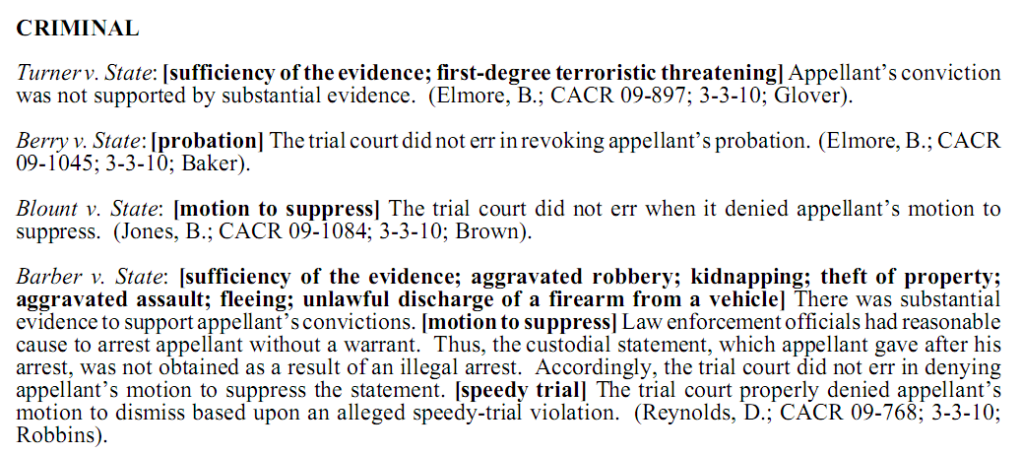
Below is a sample of the case highlights included by topic in the March volume of the Appellate Update:

Arkansas Supreme Court Overrules Previous Arkansas Appellate Court Decisions Inconsistent with the Court’s Strict Preservation Rule

Today, the Arkansas Supreme Court overruled two previous decisions that were in conflict with the Court’s holdings that require a party to make a “contemporaneous objection at trial” in order to preserve an argument for appellate review. Lamontagne v. Arkansas Department of Human Services, 2010 Ark. 190, at 7, Case No. 09-859 (April 22, 2010)

In its decision, the Court overruled its previous decision in Jones v. Abraham, 341 Ark. 66, 15 S.W.3d 310 (2000), and the Court of Appeals’s previous decision in Morrow v. Morrow, 270 Ark. 31, 603 S.W.2d 431 (Ark. App. 1980). See Lamontagne.

In 1980, the Court of Appeals observed and held in Morrow that “[t]raditionally appeals from the chancery court are reviewed de novo and there is no requirement of objections to the findings, conclusions and decree of the court to obtain review on appeal.” 270 Ark. at 33, 603 S.W.2d at 432.

In its 2000 decision in Jones, the Arkansas Supreme Court relied on the Court of Appeals’s decision in Morrow to hold that there was no requirement that a contemporaneous objection be made in order to preserve an issue for appeal. Jones, 341 Ark. at 72, 15 S.W.3d at 314. 

Today, in Lamontagne, the Court pointed out that while the Jones decision relied on Morrow, the Morrow decision–as noted by Judge Newbern in his dissent to Morrow–did not rely on any authority for its proposition that an argument can be raised in an appeal from a chancery court decision that was not made below.  In overruling Jones and Morrow, the Court relied, in part, on its 1951 decision in Umberger v. Westmoreland, 218 Ark. 632, 645, 238 S.W.2d 495, 502 (1951), in which the Court held: “we unanimously hold that in cases hereafter tried, all objections to evidence and witnesses must be made in a timely manner in the trial court, and if not so made, such objections will be considered as waived when the case reaches us on appeal.”

From the time the Umberger decision was handed down, more than fifty years ago, the Arkansas Supreme Court has consistently held that “it is incumbent on the parties to raise arguments initially to the circuit court and to give that court an opportunity to consider them.” see Roberts v. Yang, 2010 Ark. 55, at 6, ___ S.W.3d ___; see also Lamontagne, supra.  The Court’s decision today overruling previous appellate court decisions inconsistent with this position confirms that the Court has no plans to waiver from this well-settled rule, as it is frequently requested to do by attorneys.

Judge Wills, in a concurring opinion, which was joined by Judge Danielson, expresses some concern that the Court had to deal with this issue:

It is both remarkable and troubling that this question persists and this court must again clarify the necessity of raising issues below to preserve them for appeal.  I write separately to “call attention of the Bench and Bar” to this issue, as this court did in Umberger over half a century ago.

Lamontagne, 2010 Ark. 190, at 13 (Wills, J., Danielson, J., concurring).

It is hopeful that the Court’s opinion today will alleviate any confusion that caused concern on the part of the concurring justices–a confusion that, at least in part, was caused by the appellate courts’ decisions in Jones and Morrow.