The Arkansas Court of Appeals ordered rebriefing today in the following two cases:
In Fowler v. State, 2010 Ark. App. 811, the Arkansas Court of Appeals ordered rebriefing because a portion of the judgment was excluded from the addendum.
In Snyder v. State, 2010 Ark. App. 817, the Arkansas Court of Appeals ordered rebriefing because petitions for revocation were not included in the addendum.
Concurring in the Fowlerdecision, Judge David M. Glover wrote separately to “emphasize our supreme court’s mandated consequences of noncompliance with our appellate briefing rules.” For attorneys who engage in appellate practice in Arkansas, Judge Glover’s opinion is a reminder that “you can only play the game by the rules.” He warns appellate attorneys to be careful when filing appellate briefs in Arkansas’s appellate courts:
Arkansas Supreme Court Rule 4-2(a)(8) (2008) is the fulcrum for both of our rebriefing orders. Our supreme court, in City of Cotter, 2009 Ark. 172, by per curiam order, enunciated the bright-line rule to which our panel today respectfully adheres. It really does not matter that in that case, Justice Brown, in dissent, finding that the court had become far too strict in its application of the abstract rule, stated, “We have crafted yet another procedural pitfall for the appellate lawyer, which in my judgment is largely unnecessary.” Quite simply, the rule must be followed.
Twenty years ago, United States Magistrate Judge Jerry W. Cavaneau (Recalled) referenced that lawyers love to talk about “pitfalls for the unwary” in an article addressing Rule 54(b) of the Arkansas Rules of Civil Procedure. When abstracting for the Arkansas appellate courts, copier jams, basic oversights, and not adhering to the rules can be such pitfalls. I did not make the rules, but I know you can only play the game by the rules. Our rules are found in our Court Rules – Volumes 1 and 2. You really have to be careful out there, and wary.
In an attempt to put an end to the growing number of deficient briefs it had been receiving, the Arkansas Supreme Court amended Arkansas Supreme Court Rule 4-2 just last year. Among other things, that amendment was meant to provide appellate attorneys in Arkansas with more guidance concerning the contents of the appellant’s addendum. SeeArkansas Supreme Court Proposes Rule Changes as Possible Solution to Brief Deficiencies. The amended version of Rule 4-2 went into effect on January 1, 2010.
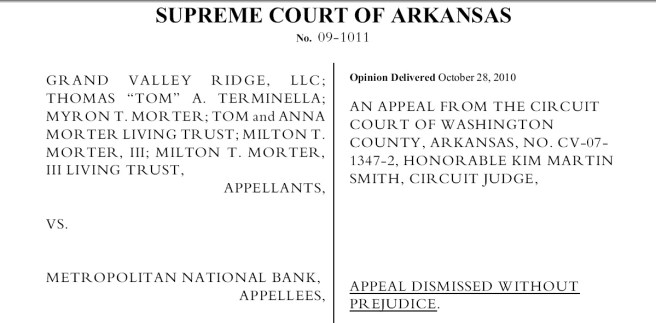
Over the past several years, “APPEAL DISMISSED WITHOUT PREJUDICE” has been a recurring disposition in opinions handed down by the Arkansas Supreme Court and the Arkansas Court of Appeals in cases where the order being appealed from was not final and failed to contain a Rule 54(b) certificate. See, e.g.,Grand Valley Ridge, LLC v. Metropolitan National Bank, 2010 Ark. 402.
Arkansas Rule of Civil Procedure 54(b) deals with the finality of orders when there are judgments relating to multiple claims or involving multiple parties. Where there has not been a final judgment with respect to all claims and all parties involved in a particular case, then an appeal from an otherwise non-appealable interlocutory order is improper unless it contains a proper Rule 54(b) certificate.
The relevant portion of Rule 54(b) provides:
(1) Certification of Final Judgment. When more than one claim for relief is presented in an action, whether as a claim, counterclaim, cross-claim, or third party claim, or when multiple parties are involved, the court may direct the entry of a final judgment as to one or more but fewer than all of the claims or parties only upon an express determination, supported by specific factual findings, that there is no just reason for delay and upon an express direction for the entry of judgment.
Rule 54(b) also provides that when the circuit court finds that an otherwise non-final order should be immediately appealable, the circuit court is required to include the following certificate within the order, immediately after the court’s signature on the judgment. That certificate is required to set forth the factual findings upon which the determination to enter the judgment as final is based. Rule 54(b) sets out the language to be included in the certificate as follows:
Rule 54(b) Certificate
With respect to the issues determined by the above judgment, the court finds:
[Set forth specific factual findings.]
Upon the basis of the foregoing factual findings, the court hereby certifies, in accordance with Rule 54(b)(1), Ark. R. Civ. P., that it has determined that there is no just reason for delay of the entry of a final judgment and that the court has and does hereby direct that the judgment shall be a final judgment for all purposes.
Certified this ________ day of ________, ________.
As shown above, Rule 54(b) includes the language that is to be included to transform what would normally be an uappealable interlocutory order into an order from which a party can properly appeal prior to a ruling by the circuit court that pertains to all claims and/or all parties. However, it is worth noting that “merely tracking the language of Rule 54(b) will not suffice; the record must show facts to support the conclusion that there is likelihood of hardship or injustice that would be alleviated by an immediate appeal rather than at the conclusion of the case.” Bank of Arkansas v. First Union National Bank, Ark. (00-1113) (Nov. 16, 2000).
Appeals are also frequently dismissed without prejudice due to the circuit court’s failure to include within the Rule 54(b) certificate the specific specific factual findings upon which a decision to enter a final judgment was based. See, e.g., Kowalski v. Rose Drugs, 2009 Ark. 524.
Failure to Include 54(b) Certificate in an Otherwise Non-Final Order
When the Rule 54(b) certificate is not attached to an order that is otherwise non-final, that order is not appealable. Appellate courts simply do not have subject-matter jurisdiction to consider the merits of an appeal where the order being appealed from is not final. See Zolliecoffer v. Mike Beebe,2010 Ark. 329; see also Ark. R. App. P. – Civil 2(a)(1). Because the lack of finality creates a jurisdictional problem, that issue is frequently raised by the appellate courts sua sponte. See Grand Valley, supra. Such appeals are dismissed without prejudice. Once the issue of the non-final order has been dealt with below (by dismissing claims and/or parties or by obtaining an order with a proper Rule 54(b) certificate), then a valid Notice of Appeal can be filed and the appeal can properly be brought before the appropriate appellate court (assuming no other procedural impediments affecting jurisdiction exist).
In Grand Valley, which was handed down by the Arkansas Supreme Court last month, there was no Rule 54(b) certificate within the otherwise non-final order. The order in that case was not final because it did not resolve all the claims that had originally been raised by Grand Valley and Terminella. Those parties had filed a motion to voluntary nonsuit without prejudice claims for negligence and interference-with-business-expectancies. The circuit court granted that motion, rendering the order that was subsequently entered in that case non-final and, therefore, not appealable.
The following are examples of cases where orders were held to be non-final and, therefore, non-appealable absent a Rule 54(b) certificate:
Voluntary nonsuit of claims–An order that is final with respect to some claims but where other claims were previously dismissed without prujudice (via a voluntary nonsuit) is not final for purposes of Rule 54(b). See, Grand Valley Ridge, supra.
Claims dismissed as to some parties and transferred as to others—An order where the claims against one defendant were dismissed and the claims against another defendant were transferred to another court. See Zolliecoffer, supra; see also Downen v. Redd, 367 Ark. 551 (2006) (holding that an order dismissing claims as to two defendants and transferring the claim as to a third defendant to another circuit court was not final for purposes of Rule 54(b)).
Unresolved claims against multiple parties—An order granting summary judgment in favor of only on defendant in a case where there are multiple defendants is not a final and appealable order unless it contains a proper Rule 54(b) certificate. See Chapman v. Wal-Mart, 351 Ark. 1 (2002).
Rule Change: Appellants Now Required to Abandon Stray Claims in Notice of Appeal
Effective July 1, 2010 Arkansas Rule of Appellate Procedure-Civil 3(e)(vi) requires a notice of appeal to state, among other things, that “the appealing party abandons any pending but unresolved claim.” The new rule causes the abandonment of any unresolved claims in the notice of appeal to operate as a dismissal with prejudice of any stray claims in a case where the order being appealed from would otherwise be final.
The comments to the rule change further explain its purpose:
This amendment will cure a recurring finality problem. Too often—after the parties have paid for the record, filed it, and filed all their briefs on appeal—the appellate court will discover that what appears to be a final order or judgment is not final because a pleaded claim, counterclaim, or cross-claim remains unadjudicated. This kind of stray claim destroys finality and renders an otherwise final order or judgment unappealable. E.g., Ramsey v. Beverly Enters., Inc., 375 Ark. 424, 291 S.W.3d 185 (2009); Rigsby v. Rigsby, 340 Ark. 544, 11 S.W.3d 551 (2000); Brasfield v. Murray, 96 Ark. App. 207, 239 S.W.3d 551 (2006). These stray claims often appear to have been forgotten by the parties or abandoned even though no order resolved them. It wastes parties’ and courts’ scarce resources to have two appeals in these situations.
A party taking an interlocutory appeal or cross-appeal authorized by the Arkansas Rules of Appellate Procedure, the Rules of the Supreme Court and Court of Appeals, or precedent, should not make this statement in the parties’ notice. Nor is this statement required in a notice of appeal or cross-appeal from a judgment certified by the circuit court as final under Rule of Civil Procedure 54(b). In all these situations, which are in essence interlocutory appeals, some claims remain pending and viable in the circuit court during the appeal.
These comments don’t address what happens where the party who did not bring the lingering claims (usually the defendant) is the party appealing from the non-final order. Presumably a defendant who chooses to appeal from a non-final order could not abandon claims that were originally brought by the plaintiff. It seems that in those situations, the defendant should obtain a Rule 54(b) certificate in order to appeal from an otherwise non-final order.
It is also worth noting that this statement doesn’t help cure finality problems deriving from the failure to obtain a final order with respect to all parties. A prior change to Rule 54 alleviates that problem with respect to John Doe defendants who were named in the lawsuit but who were never known and, thus, never served during the litigation. Effective January 1, 2009, the Arkansas Supreme Court amended Rule 54 to provide that “[a]ny claim against a named but unserved defendant, including a ‘John Doe’ defendant, is dismissed by the circuit court’s final judgment or decree.” Ark. R. Civ. P. 54(b)(5); see Jackson v. Sparks Regional Medical Center, 375 Ark. 533 (2009) (holding that Rule 54(b)(5) could be applied retroactively).
Though appellate lawyers in Arkansas should review the entire text of the rule, below are the primary changes and clarifications resulting from the revisions:
The party seeking the stay must show that the petition for a writ of certiorari presents a substantial question, and that there is good cause for a stay or recall. The previous rule required only that the party seeking the stay order a copy of the record from the Clerk and pay a $50 deposit for the record. (This requirement remains in the new rule). Ark. Sup. Ct. R. 5-3(c)(1).
The stay will be no longer than ninety days, unless the Petition for Writ of Certiorari is actually filed. (Ninety days is generally the deadline for filing a Petition for Writ of Certiorari with the U.S. Supreme Court. U.S. Sup. Ct. R. 13(1).) The time period can be extended upon a showing of good cause. If the Petition is actually filed, the stay remains in place until the Supreme Court’s final disposition of the case. Ark. Sup. Ct. R. 5-3(c)(2).
If the Petition for Writ of Certiorari is denied, the mandate issues immediately. Ark. Sup. Ct. R. 5-3(c)(4).
Along with its decision to publish opinions handed down after July 1, 2009 in an electronic-only format, the Court also implemented a new citation rule for those electronically published decisions. SeeArk. Sup. Ct. R. 5-2(d)(2).
As shown in the chart below, Arkansas’s new citation rule for electronically reported decisions is somewhat different from the traditional citation rule for decisions published in the bound volumes of the Arkansas Reports and the Arkansas Appellate Reports.
The new citation format for electronically published decisions permits parallel citations to unofficial sources, including unofficial electronic databases, but only when the regional reporter citation is unavailable. (Parallel citations are highlighted in green in the chart below). Notice also that, the new citation format omits the parenthetical with the year the case was issued because the year is now the first number in the citation.
Additionally, the new citation rule requires a different format for pinpoint citations. Arkansas Supreme Court Rule 5-2(d) strongly encourages the use of pinpoint citations for citations to all Arkansas opinions. The use of pinpoint citations with the new citation format differs from the traditional citation format in two respects. (Pinpoint citations are highlighted in yellow in the chart below).
First, the use of pinpoint citations with the new format always requires the use of the word “at.” When citing to cases that are published in the printed version of the Arkansas Reports, the traditional citation rule requires the use of the word “at” only when using short cites, and never when using full citations of a case.
Second, the pinpoint citation will always refer to the page of the opinion itself rather than a page in a published reporter. Unlike opinions published in the Arkansas Reports, every opinion published electronically begins with page 1. Providing the correct pinpoint citation under the new citation format now requires attorneys to find the decision online and then refer to the specific page of that decision where the information being cited is found.
The following chart, based on Arkansas Supreme Court Rule 5-2(d), illustrates the differences between the traditional citation format and the new citation format:
Citing to Arkansas Opinions (Rule 5-2(d))
Locating Page Numbers for Pinpoint Citations to Arkansas’s Electronically Reported Decisions
The Arkansas Judiciary Website
Arkansas’s electronically reported decisions can be found on the Arkansas Judiciary website. Although not as powerful as the search tools provided by electronic legal research databases such as Westlaw, LexisNexis, and fastcase, a search tool is available on the Arkansas Judiciary’s website that allows attorneys to search for electronically reported cases handed down by the Arkansas Supreme Court and the Arkansas Court of Appeals.
Electronic Legal Research Databases: Westlaw vs. Fastcase
While the electronically published decisions are available on the Arkansas Judiciary’s website, most appellate attorneys who subscribe to online legal research databases–such as Westlaw and fastcase–will begin their legal research with those tools. Surprisingly, Westlaw does not seem to provide the page numbers for Arkansas opinions that are available in the electronic-only format. Fastcase, however, does include the specific page numbers for those decisions.
As an appellate attorney who subscribes to Westlaw Next, I typically begin my legal research with Westlaw. When I need to cite to a recent Arkansas decision (handed down since February of 2009) in an appellate brief, however, I also now have to find that decision using either the Arkansas Judiciary website or fastcase to find the specific page number to include as a pinpoint citation.
To make sense of all of this, if you are a Westlaw subscriber, then conduct a Westlaw search for the case of W.E. Pender & Sons, Inc. v. Lee, 2010 Ark. 52, 2010 WL 391332, a February 4, 2010 decision of the Arkansas Supreme Court (type “2010 Ark. 52” in your Westlaw search box for this result). You should notice that Westlaw does not provide the official page numbers for that case–(Although Westlaw sometimes provides star pages, I have not found a recent decision where Westlaw provides official page numbers for that decision).
If you have access to fastcase, now conduct a search for the same case within your fastcase search box, and notice how the material included on each page is clearly labeled by page numbers along the left side of the page (“Page 1,” “Page 2,” etc.). If you do not subscribe to fastcase, you should know that if you are a member of the Arkansas Bar Association, your membership includes a free subscription to fastcase. Contact the Arkansas Bar Association for details.
As a subscriber to Westlaw, I am hopeful that it will eventually catch up with Arkansas’s new electronic opinion format and include page numbers to those opinions so that Arkansas appellate attorneys who subscribe to Westlaw can more easily include pinpoint citations in their appellate briefs. Until then, Arkansas appellate attorneys who subscribe to Westlaw will be required to access other online tools to find the pinpoint citations for decisions issued in Arkansas’s new electronic format.
If anyone has had a different experience using Westlaw than what I have described, I would be interested in knowing that—please e-mail me at Tasha@TaylorLawFirm.com to share your experience. I would also be interested in knowing whether LexisNexis provides page numbers that correlate to those published in the official electronic reports, as we do not subscribe to that database.
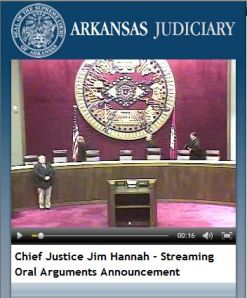
This morning, we attended the Arkansas Supreme Court’s press conference announcing that live streaming videos of oral arguments presented in Arkansas’s appellate courts will be available beginning this week. Governor Mike Beebe was in attendance at the Court’s press conference along with members of the Arkansas Court of Appeals, Arkansas Bar Association President Jim Julian, members of the Arkansas bar, a representative from AETN, and staff members from the courts. Rather than make the announcement in person, Chief Justice Hannah and the other justices made the announcement via live streaming video from the courtroom, which was broadcast to a conference room in the Justice Building. (The justices later visited the conference room to make additional comments.) Below you will find a short video of the first minute or so of that press conference.
This Thursday marks the first day that the Arkansas Supreme Court will stream its oral arguments live to the Internet. Chief Justice Hannah described this as “an historic moment for Arkansas,” and an example of the Court’s committment to “providing greater access to justice and to facilitating a better understanding of the judiciary.”
While acknowledging that courts seldom welcome change, Chief Justice Hannah noted the monumental ways in which our Arkansas Supreme Court has been moving forward and embracing technological advances at a faster rate than other state appellate courts. Last year, Arkansas became the first state in the country to designate its electronic record as the official opinion of the court, a decision which saves Arkansas around $300,000 in publication costs each year. Other states and the federal judiciary are now looking to Arkansas as the leader on this front. With today’s announcement, Arkansas joins only half of state appellate courts in the nation offering a live broadcast of oral arguments, and Arkansas joins only fifteen states that allow their videos of oral arguments to be archived online. AETN is developing plans to broadcast the oral arguments as well.
Click above to view this morning's full video announcement from the Arkansas Supreme Court about live video streaming of oral arguments on the Internet.
The use of cameras in the courtroom has been a topic of discussion among members of the Court for the past several years. In the Spring of 2007, Associate Justice Robert L. Brown of the Arkansas Supreme Court wrote an article that was published in The Journal of Appellate Practice and Process entitled Just a Matter of Time? Video Cameras at the United States Supreme Court and the State Supreme Courts. In his article, Justice Brown discussed arguments for and against the use of cameras in appellate courts. The pros include more transparency in government, public education, and an increase in understanding of and respect for the judicial process. The cons include potential grandstanding by attorneys or justices, the possibility of unfavorable video clips being taken out of context by the media (in states where appellate judges are elected) or by political opponents, and problems with open microphones (where justices’ comments between oral arguments are picked up and potentially broadcast by the court’s sound system).
Justice Brown is no doubt an ardent supporter behind the Arkansas Supreme Court’s decision to permit live broadcasts of oral arguments in Arkansas’s appellate courts. In fact, Justice Brown has long argued that the United States Supreme Court should adopt a similar policy of permitting cameras in the courtroom. Following Chief Justice Hannah’s remarks this morning, Justice Brown called on the Supreme Court of the United States to follow the lead of Arkansas, arguing that “it’s time, I believe, for the United States Supreme Court also to either broadcast, or televise, or webcast their oral arguments.” Justice Brown is hopeful that this might soon happen with the entrance of Justice Sonia M. Sotomayor and Justice Elena Kagan to the Court.
While this is certainly a big day for Arkansas appellate courts and Arkansas appellate attorneys, it probably goes without saying that the thought that anyone in the world could be watching their oral arguments will keep appellate attorneys on their toes!
In a press release dated June 28, 2010, the Administrative Office of the Courts announces that the final bound volume of the Arkansas Reports and Arkansas Appellate Reports has been issued.
The final issue of the Arkansas Reports comes one hundred and seventy-three years after its first publication. Arkansas is the first state in the country to eliminate the use of bound volumes of the appellate courts’ opinions. SeeAct 221 of 2009. The final bound volume of the Arkansas Reports includes decisions from November 5, 2008 to February 12, 2009. All opinions of the Arkansas Supreme Court and Court of Appeals handed down on or after February 14, 2009 are officially published as electronic versions, which can be found on the judiciary’s web site.
In a recent per curiam, the Arkansas Supreme Court adopted all but three of the proposed appellate rule changes that were proposed and made available for public comment earlier this year.
The rule change that was adopted by the Court that probably has the greatest impact on practicing appellate attorneys is the addition of Ark. R. App. P.–Civ. 3(e)(vi). That rule requires that in a notice of appeal, the appealing party must state that it abandons any pending but unresolved claims. There are, of course, some circumstances in which this statement isn’t required, such as in the case of an interlocutory appeal, for example. The purpose of the rule is to prevent a finality problem that often arises at the appellate level. This often occurs when there is some unresolved claim that was, for all practical purposes, abandoned by a party but never formally abandoned by an order entered at the trial court level.
In addition to that change, the following is a summary of the other changes made to the Arkansas Rules of the Supreme Court and Court of Appeals:
An 18-day limit to file a motion to reconsider any order or decision on any motion (2-1(g)).
An increase in the number of briefs that must be filed in certain circumstances (2-4(e), 4-1(d), 4-4(a)-(c)).
A change in the way oral arguments are scheduled (5-1(a), (b)).
A limit of 15 pages for certain petitions (6-1(e)).
A change to the way extensions are handled in dependency-neglect cases (6-9(d), (e))
The Court also made a change to Arkansas Rules of Appellate Procedure 2, adding a subsection (13) that allows civil or criminal contempt orders to be appealed from the circuit court directly to the Arkansas Supreme Court.
The Court declined to adopt three proposed changes that relate to appellate practice. First, the Court declined to adopt the proposed addition of section(d) to Ark. R. App. P.–Civ. 5, which would have made the untimely filing of a record a disciplinary issue for the attorney, but would have removed the jurisdictional element (meaning that the appellate courts would still hear the appeal, even if the record was not timely filed). The second change that the Court declined to adopt was the proposed addition of subdivision (e) to Rule of the Supreme Court and Court of Appeals 4-1, which would have mandated color-coding of briefs. (As a side note, we had begun color-coding briefs [the current rules do not prohibit this], but are reconsidering that decision. It is our understanding that there are logistical reasons that the Court prefers not to have color-coded briefs at the current time.) Third, rather than completely rewriting Rule of the Supreme Court and Court of Appeals 2-1 (relating to motion practice), the Court simply adopted proposed subdivision (g), which, as mentioned above, sets an 18-day time limit for filing a motion to reconsider a ruling on any motion covered by that rule.
Today’s per curiam from the Arkansas Supreme Court–In Re Amendment to Administrative Order No. 6–permits broadcasting, recording, and photography in appellate proceedings in the Arkansas Supreme Court and the Arkansas Court of Appeals.
This big change in the way Arkansas’s appellate courts do business comes with a lengthy set of rules governing the use of cameras in the courtrooms–the following is a summary of some of the highlights from the amendments to Administrative Order Number 6 that govern the use of cameras and electronic devices in all courtrooms across the state:
Judges may authorize broadcasting, recording, or photographing in the courtroom and the areas adjacent to the courtroom throughout the proceedings, recesses, etc., as long as the participants will not be distracted and the dignity of the proceedings will not be impaired.With a timely objection, parties or attorneys can preclude broadcasting, recording, or photographing of the proceeding.
Witnesses have a right to refuse to be broadcast, recorded, or photographed.
Jurors, minors without parental or guardian consent, victims in cases involving sexual offenses, and undercover police agents or informants shall not be broadcast, recorded, or photographed.
Juvenile matters, probate matters, and domestic relations matters shall not be subject to broadcasting, recording, or photographing.
Judges will retain ultimate control of the application of the rules and their decisions will be final and not subject to appeal. At any time, the court may determine in its discretion to terminate the broadcast, recording, or photography.
Only two cameras will be permitted in the courtroom during a trial: one camera for still photography and one for video/television photography. The media will have a pooling arrangement whereby representatives of the news media will share the photography and video footage. If the court has its own broadcasting, recording, or photography system, the court’s system shall be used, unless the court determines otherwise.
Electronic devices cannot be used in courtrooms to broadcast, record, photograph, e-mail, blog, tweet, text, post, or transmit information by any other means except as may be allowed by the court.
Oral arguments at the Arkansas Supreme Court and Court of Appeals may be recorded, broadcasted, or webcasted through a live or tape-delayed format as the Supreme Court shall direct. The Supreme Court’s courtroom is being equipped with a system to record and broadcast oral arguments that the Court plans to implement in the 2010 Fall Term of the Court. Those recordings will be retained at the Clerk’s office and may be purchased for a cost to be set by the Court to cover the cost of the copies. Objections to the recording of oral arguments and other appellate proceedings may be made to the Court.
Attention appellate attorneys: recognizing that you might already feel a bit like Goldilocks–somewhat lost while meandering through a forest of rules and requirements to attempt to create the perfect brief–you will probably not feel as comforted as she was to hear the characterization “just right” with respect to creating the perfect appellant’s addendum. That was the message at the conclusion of yesterday’s decision in West Memphis Adolescent Residential, LLC v. J.T. Compton, et al., 2010 Ark. App. 450, — S.W.3d — (2010), which includes a notice “[f]or the benefit of the appellate bar” calling appellate attorneys to create addenda that are neither too big nor too small.
The Arkansas Court of Appeals explained that Rule 4-2(a)(8) requires that the documents contained in the appellant’s addendum not be too many or too few. Rather, an addendum must contain only those documents necessary to an understanding of the issues on appeal or the appellate court’s jurisdiction:
For the benefit of the appellate bar, we note that WMAR has included many unnecessary documents in its addendum, such as multiple copies of the various contracts and leases; motions to dismiss and orders denying the motions; motions and orders on discovery disputes; motions in limine; scheduling orders; orders extending the time to respond to summary judgment motions; and protective orders. None of these documents were necessary to the arguments made on appeal. They total more than 150 pages of an addendum that contains 742 pages. Under Supreme Court Rule 4-2(a)(8), the contents of the addendum are to be limited to only those items necessary to an understanding of the issues on appeal or our jurisdiction. We have pointed out that an abstract and addendum can be deficient for containing too much material, as well as too little.See American Transp. Corp. v. Exchange Capital Corp., 84 Ark. App. 28, 129 S.W.3d 312 (2003); Miller v. Hometown Propane Gas, Inc., 82 Ark. App. 82, 110 S.W.3d 304 (2003).
Arkansas Supreme Court Rule 4-2(a)(8) specifically requires that the addendum “shall not merely reproduce the entire record of trial court filings” but that it should contain those documents “that are essential for the appellate court to confirm its jurisdiction, to understand the case, and to decide the issues on appeal.”
For those who are still wondering how to create an addendum that is “just right,” the first place to start is by reviewing Arkansas Supreme Court Rule 4-2(a)(8), which provides much more advice to attorneys than the rule previously did. For example, Rule 4-2(a)(8) now contains a bulleted list of the documents that the addendum absolutely must contain, which provides a great starting point for determining which documents to include in an addendum. Of course, each case is unique so there will most likely be other documents, outside of that list, that also must be included in order to create an addendum that includes all the documents in your case “that are essential for the appellate court to confirm its jurisdiction, to understand the case, and to decide the issues on appeal.” SeeArk. Sup. Ct. R. 4-2(a)(8).
The following article, which originally appeared in the Arkansas Real Estate Review of the Arkansas Bar Association Real Estate Section, will be of interest to those who practice appellate law in Arkansas. In the article, Professor Lynn Foster, Arkansas Bar Foundation Professor of Law at the UALR William H. Bowen School of Law, writes that West is no longer publishing all reported decisions of the Arkansas Court of Appeals or Arkansas Supreme Court in the South Western Reporter (recall that all Arkansas Court of Appeals and Arkansas Supreme Court decisions are now reported pursuant to Rule 5-2). In addition, a rather confusing header that appears at the top of these cases in Westlaw gives the impression that the cases have no precedential value, when, in fact, they do. The fact that decisions of the Arkansas Court of Appeals and Arkansas Supreme Court are not being published in the South Western Reporter is yet another reason that we believe using electronic research databases is the better method of researching these days (we use Westlaw at Cullen & Co.). The full text of the article is available after the jump (click the “More” link).
Incidentally, I highly recommend that you join the Real Estate Section of the Arkansas Bar Association, if for no other reason than to receive the Arkansas Real Estate Review.


 ArkansasAppeals.com