
Hear Ye, Hear Ye, the Arkansas Supreme Court is Now in Session . . . Live & Online!

This morning, we attended the Arkansas Supreme Court’s press conference announcing that live streaming videos of oral arguments presented in Arkansas’s appellate courts will be available beginning this week.  Governor Mike Beebe was in attendance at the Court’s press conference along with members of the Arkansas Court of AppealsArkansas Bar Association President Jim Julian, members of the Arkansas bar, a representative from AETN, and staff members from the courts.  Rather than make the announcement in person, Chief Justice Hannah and the other justices made the announcement via live streaming video from the courtroom, which was broadcast to a conference room in the Justice Building.  (The justices later visited the conference room to make additional comments.)  Below you will find a short video of the first minute or so of that press conference.

This Thursday marks the first day that the Arkansas Supreme Court will stream its oral arguments live to the Internet.  Chief Justice Hannah described this as “an historic moment for Arkansas,” and an example of the Court’s committment to “providing greater access to justice and to facilitating a better understanding of the judiciary.”

While acknowledging that courts seldom welcome change, Chief Justice Hannah noted the monumental ways in which our Arkansas Supreme Court has been moving forward and embracing technological advances at a faster rate than other state appellate courts.  Last year, Arkansas became the first state in the country to designate its electronic record as the official opinion of the court, a decision which saves Arkansas around $300,000 in publication costs each year.  Other states and the federal judiciary are now looking to Arkansas as the leader on this front.  With today’s announcement, Arkansas joins only half of state appellate courts in the nation offering a live broadcast of oral arguments, and Arkansas joins only fifteen states that allow their videos of oral arguments to be archived online.  AETN is developing plans to broadcast the oral arguments as well.

The final stage in the Court’s efforts to embrace technology is eventually to make all pleadings available online, a project that is currently underway.  In fact, the Administrative Office of the Courts recently announced its request for proposals for a vendor to develop such a system.
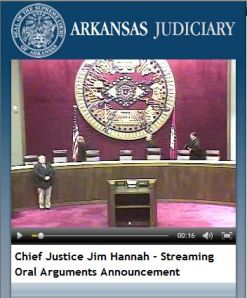
Arkansas appellate attorneys to argue live online.
Click above to view this morning's full video announcement from the Arkansas Supreme Court about live video streaming of oral arguments on the Internet.

The use of cameras in the courtroom has been a topic of discussion among members of the Court for the past several years.  In the Spring of 2007, Associate Justice Robert L. Brown of the Arkansas Supreme Court wrote an article that was published in The Journal of Appellate Practice and Process entitled Just a Matter of Time? Video Cameras at the United States Supreme Court and the State Supreme Courts.  In his article, Justice Brown discussed arguments for and against the use of cameras in appellate courts.  The pros include more transparency in government, public education, and an increase in understanding of and respect for the judicial process.  The cons include potential grandstanding by attorneys or justices, the possibility of unfavorable video clips being taken out of context by the media (in states where appellate judges are elected) or by political opponents, and problems with open microphones (where justices’ comments between oral arguments are picked up and potentially broadcast by the court’s sound system).

Justice Brown is no doubt an ardent supporter behind the Arkansas Supreme Court’s decision to permit live broadcasts of oral arguments in Arkansas’s appellate courts.  In fact, Justice Brown has long argued that the United States Supreme Court should adopt a similar policy of permitting cameras in the courtroom.  Following Chief Justice Hannah’s remarks this morning, Justice Brown called on the Supreme Court of the United States to follow the lead of Arkansas, arguing that “it’s time, I believe, for the United States Supreme Court also to either broadcast, or televise, or webcast their oral arguments.”  Justice Brown is hopeful that this might soon happen with the entrance of Justice Sonia M. Sotomayor and Justice Elena Kagan to the Court. 

While this is certainly a big day for Arkansas appellate courts and Arkansas appellate attorneys, it probably goes without saying that the thought that anyone in the world could be watching their oral arguments will keep appellate attorneys on their toes!

For more information about the Supreme Court’s rule permitting cameras to be used in appellate court proceedings, visit our previous blog post entitled Arkansas Supreme Court Permits Cameras in Appellate Proceedings.

To view other news stories on this topic, click on the following links:

Arkansas Supreme Court to Announce Details of the Use of Cameras in Appellate Court Proceedings

On May 27, 2010, the Arkansas Supreme Court handed down a per curiam decision announcing its decision to permit broadcasting in appellate proceedings.  See In Re Amendment to Administrative Order No. 6.  In that per curiam, the Court generally described its plans to permit cameras in the courtroom: “Oral arguments at the Arkansas Supreme Court and Court of Appeals may be recorded, broadcasted, or webcasted through a live or tape-delayed format as the Supreme Court shall direct.” Id.  According to that opinion the Court will begin implementing the recording and broadcasting system in the 2010 Fall Term of the Court, which has just gotten underway.  Tomorrrow, the Court plans to announce more details about its decision to stream oral arguments online.  We’ll update the blog with more details after tomorrow’s announcement.


Arkansas Appellate Courts Update–Court of Appeals Motions Conference; Fall Term 2010

The Arkansas Court of Appeals met this week for its end of summer motions conference.  The results are included in the Court’s August 25, 2010 Syllabus

The summer recess for Arkansas’s appellate courts will soon be over, as both courts begin their fall terms within the next couple of weeks.  The courts will hear their first oral arguments of the fall term on September 15, 2010 (Court of Appeals), and September 16, 2010 (Supreme Court).

Coming Soon: Judiciary Website Overhaul

Stephanie Harris, Arkansas Supreme Court Communications Counsel, is seeking suggestions from attorneys for the Arkansas Judiciary’s new website.  If you have ideas for how the website could be more user-friendly or helpful please submit your comments and suggestions to Ms. Harris.  Her e-mail is Stephanie.M.Harris@arkansas.gov, and her telephone number is (501) 371-2004.  All comments and suggestions will remain confidential.

The End of an Era: Final Bound Volume of Arkansas Reports Issued

In a press release dated June 28, 2010, the Administrative Office of the Courts announces that the final bound volume of the Arkansas Reports and Arkansas Appellate Reports has been issued.

The final issue of the Arkansas Reports comes one hundred and seventy-three years after its first publication.  Arkansas is the first state in the country to eliminate the use of bound volumes of the appellate courts’ opinions. See Act 221 of 2009.  The final bound volume of the Arkansas Reports includes decisions from November 5, 2008 to February 12, 2009.  All opinions of the Arkansas Supreme Court and Court of Appeals handed down on or after February 14, 2009 are officially published as electronic versions, which can be found on the judiciary’s web site.


Governor Beebe Appoints Raymond Abramson to Arkansas Court of Appeals

Governor Mike Beebe recently appointed Raymond Abramson of Holly Grove as the Associate Judge for District 1, Position 2 on the Arkansas Court of Appeals, filling the vacancy left by the resignation of Judge Price Marshall, who was recently confirmed as a federal judge.  Abramson will serve in this position through 2012.  The voters of the 12 east-Arkansas counties that make up District 1 will elect a judge to fill the remaining two years of Marshall’s term.

Arkansas Supreme Court Adopts Rule Changes

In a recent per curiam, the Arkansas Supreme Court adopted all but three of the proposed appellate rule changes that were proposed and made available for public comment earlier this year.

The rule change that was adopted by the Court that probably has the greatest impact on practicing appellate attorneys is the addition of Ark. R. App. P.–Civ. 3(e)(vi).   That rule requires that in a notice of appeal, the appealing party must state that it abandons any pending but unresolved claims.   There are, of course, some circumstances in which this statement isn’t required, such as in the case of an interlocutory appeal, for example.  The purpose of the rule is to prevent a finality problem that often arises at the appellate level.  This often occurs when there is some unresolved claim that was, for all practical purposes, abandoned by a party but never formally abandoned by an order entered at the trial court level.

In addition to that change, the following is a summary of the other changes made to the Arkansas Rules of the Supreme Court and Court of Appeals:

  • An 18-day limit to file a motion to reconsider any order or decision on any motion (2-1(g)).
  • An increase in the number of briefs that must be filed in certain circumstances (2-4(e), 4-1(d), 4-4(a)-(c)).
  • A change in the way oral arguments are scheduled (5-1(a), (b)).
  • A limit of  15  pages for certain petitions  (6-1(e)).
  • A change to the way extensions are handled in dependency-neglect cases (6-9(d), (e))

The Court also made a change to Arkansas Rules of Appellate Procedure 2, adding a subsection (13) that allows civil or criminal contempt orders to be appealed from the circuit court directly to the Arkansas Supreme Court.

The Court declined to adopt three proposed changes that relate to appellate practice.  First, the Court declined to adopt the proposed addition of section(d) to Ark. R. App. P.–Civ. 5, which would have made the untimely filing of a record a disciplinary issue for the attorney, but would have removed the jurisdictional element (meaning that the appellate courts would still hear the appeal, even if the record was not timely filed).  The second change that the Court declined to adopt was the proposed addition of subdivision (e) to Rule of  the Supreme Court and Court of Appeals 4-1, which would have mandated color-coding of briefs.  (As a side note, we had begun color-coding briefs [the current rules do not prohibit this], but are reconsidering that decision.  It is our understanding that there are logistical reasons that the Court prefers not to have color-coded briefs at the current time.)  Third, rather than completely rewriting Rule of the Supreme Court and Court of Appeals 2-1 (relating to motion practice), the Court simply adopted proposed subdivision (g), which, as mentioned above, sets an 18-day time limit for filing a motion to reconsider a ruling on any motion covered by that rule.

Arkansas Supreme Court To Permit Cameras In Appellate Proceedings

Today’s per curiam from the Arkansas Supreme Court–In Re Amendment to Administrative Order No. 6–permits broadcasting, recording, and photography in appellate proceedings in the Arkansas Supreme Court and the Arkansas Court of Appeals.

This big change in the way Arkansas’s appellate courts do business comes with a lengthy set of rules governing the use of cameras in the courtrooms–the following is a summary of some of the highlights from the amendments to Administrative Order Number 6 that govern the use of cameras and electronic devices in all courtrooms across the state:

  • Judges may authorize broadcasting, recording, or photographing in the courtroom and the areas adjacent to the courtroom throughout the proceedings, recesses, etc., as long as the participants will not be distracted and the dignity of the proceedings will not be impaired.With a timely objection, parties or attorneys can preclude broadcasting, recording, or photographing of the proceeding.
  • Witnesses have a right to refuse to be broadcast, recorded, or photographed.
  • Jurors, minors without parental or guardian consent, victims in cases involving sexual offenses, and undercover police agents or informants shall not be broadcast, recorded, or photographed.
  • Juvenile matters, probate matters, and domestic relations matters shall not be subject to broadcasting, recording, or photographing.
  • Judges will retain ultimate control of the application of the rules and their decisions will be final and not subject to appeal.  At any time, the court may determine in its discretion to terminate the broadcast, recording, or photography. 
  • Only two cameras will be permitted in the courtroom during a trial: one camera for still photography and one for video/television photography.  The media will have a pooling arrangement whereby representatives of the news media will share the photography and video footage.  If the court has its own broadcasting, recording, or photography system, the court’s system shall be used, unless the court determines otherwise.
  • Electronic devices cannot be used in courtrooms to broadcast, record, photograph, e-mail, blog, tweet, text, post, or transmit information by any other means except as may be allowed by the court.
  • Oral arguments at the Arkansas Supreme Court and Court of Appeals may be recorded, broadcasted, or webcasted through a live or tape-delayed format as the Supreme Court shall direct.  The Supreme Court’s courtroom is being equipped with a system to record and broadcast oral arguments that the Court plans to implement in the 2010 Fall Term of the Court.  Those recordings will be retained at the Clerk’s office and may be purchased for a cost to be set by the Court to cover the cost of the copies.  Objections to the recording of oral arguments and other appellate proceedings may be made to the Court.

Arkansas Supreme Court Rule 4-2 Requires Appellant’s Addendum To Be “Just Right”

Attention appellate attorneys: recognizing that you might already feel a bit like Goldilocks–somewhat lost while meandering through a forest of rules and requirements to attempt to create the perfect brief–you will probably not feel as comforted as she was to hear the characterization “just right” with respect to creating the perfect appellant’s addendum.  That was the message at the conclusion of yesterday’s decision  in West Memphis Adolescent Residential, LLC v. J.T. Compton, et al., 2010 Ark. App. 450, — S.W.3d — (2010), which includes a notice “[f]or the benefit of the appellate bar” calling appellate attorneys to create addenda that are neither too big nor too small.

The Arkansas Court of Appeals explained that Rule 4-2(a)(8) requires that the documents contained in the appellant’s addendum not be too many or too few.  Rather, an addendum must contain only those documents necessary to an understanding of the issues on appeal or the appellate court’s jurisdiction:

For the benefit of the appellate bar, we note that WMAR has included many unnecessary documents in its addendum, such as multiple copies of the various contracts and leases; motions to dismiss and orders denying the motions; motions and orders on discovery disputes; motions in limine; scheduling orders; orders extending the time to respond to summary judgment motions; and protective orders. None of these documents were necessary to the arguments made on appeal. They total more than 150 pages of an addendum that contains 742 pages. Under Supreme Court Rule 4-2(a)(8), the contents of the addendum are to be limited to only those items necessary to an understanding of the issues on appeal or our jurisdiction. We have pointed out that an abstract and addendum can be deficient for containing too much material, as well as too little. See American Transp. Corp. v. Exchange Capital Corp., 84 Ark. App. 28, 129 S.W.3d 312 (2003); Miller v. Hometown Propane Gas, Inc., 82 Ark. App. 82, 110 S.W.3d 304 (2003).

West Memphis Adolescent Residential, LLC, 2010 Ark. App. 450, at 12, — S.W.3d —, — (emphasis added).

Arkansas Supreme Court Rule 4-2(a)(8) specifically requires that the addendum “shall not merely reproduce the entire record of trial court filings” but that it should contain those documents “that are essential for the appellate court to confirm its jurisdiction, to understand the case, and to decide the issues on appeal.” 

Arkansas Supreme Court Rule 4-2 was amended in 2009 to provide more guidance to appellate attorneys concerning, among other things, the contents of the appellant’s addendum. See previous blog post, Arkansas Supreme Court Proposes Rule Changes as Possible Solution to Brief Deficiencies.  The amended version of Rule 4-2 went into effect on January 1, 2010.  Yesterday’s announcement to the appellate bar by the Arkansas Court of Appeals echos previous warnings from the Arkansas Supreme Court concerning deficiencies in briefs that led to the 2009 rule changes, which brought significant amendments to Rule 4-2, governing the contents of briefs on appeal. See, e.g., In re Appellate Practice Concerning Defective Briefs, 369 Ark. App’x 553 (2007); In Re: Arkansas Supreme Court and Court of Appeals Rules 4-1 and 4-2.

For those who are still wondering how to create an addendum that is “just right,” the first place to start is by reviewing Arkansas Supreme Court Rule 4-2(a)(8), which provides much more advice to attorneys than the rule previously did.  For example, Rule 4-2(a)(8) now contains a bulleted list of the documents that the addendum absolutely must contain, which provides a great starting point for determining which documents to include in an addendum.  Of course, each case is unique so there will most likely be other documents, outside of that list, that also must be included in order to create an addendum that includes all the documents in your case “that are essential for the appellate court to confirm its jurisdiction, to understand the case, and to decide the issues on appeal.” See Ark. Sup. Ct. R. 4-2(a)(8)