The Arkansas Court of Appeals ordered rebriefing today in the following two cases:
In Fowler v. State, 2010 Ark. App. 811, the Arkansas Court of Appeals ordered rebriefing because a portion of the judgment was excluded from the addendum.
In Snyder v. State, 2010 Ark. App. 817, the Arkansas Court of Appeals ordered rebriefing because petitions for revocation were not included in the addendum.
Concurring in the Fowlerdecision, Judge David M. Glover wrote separately to “emphasize our supreme court’s mandated consequences of noncompliance with our appellate briefing rules.” For attorneys who engage in appellate practice in Arkansas, Judge Glover’s opinion is a reminder that “you can only play the game by the rules.” He warns appellate attorneys to be careful when filing appellate briefs in Arkansas’s appellate courts:
Arkansas Supreme Court Rule 4-2(a)(8) (2008) is the fulcrum for both of our rebriefing orders. Our supreme court, in City of Cotter, 2009 Ark. 172, by per curiam order, enunciated the bright-line rule to which our panel today respectfully adheres. It really does not matter that in that case, Justice Brown, in dissent, finding that the court had become far too strict in its application of the abstract rule, stated, “We have crafted yet another procedural pitfall for the appellate lawyer, which in my judgment is largely unnecessary.” Quite simply, the rule must be followed.
Twenty years ago, United States Magistrate Judge Jerry W. Cavaneau (Recalled) referenced that lawyers love to talk about “pitfalls for the unwary” in an article addressing Rule 54(b) of the Arkansas Rules of Civil Procedure. When abstracting for the Arkansas appellate courts, copier jams, basic oversights, and not adhering to the rules can be such pitfalls. I did not make the rules, but I know you can only play the game by the rules. Our rules are found in our Court Rules – Volumes 1 and 2. You really have to be careful out there, and wary.
In an attempt to put an end to the growing number of deficient briefs it had been receiving, the Arkansas Supreme Court amended Arkansas Supreme Court Rule 4-2 just last year. Among other things, that amendment was meant to provide appellate attorneys in Arkansas with more guidance concerning the contents of the appellant’s addendum. SeeArkansas Supreme Court Proposes Rule Changes as Possible Solution to Brief Deficiencies. The amended version of Rule 4-2 went into effect on January 1, 2010.
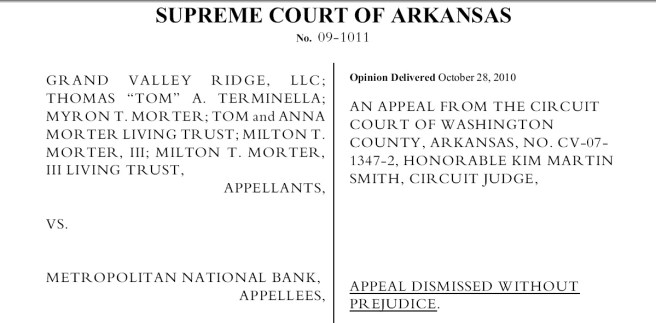
Over the past several years, “APPEAL DISMISSED WITHOUT PREJUDICE” has been a recurring disposition in opinions handed down by the Arkansas Supreme Court and the Arkansas Court of Appeals in cases where the order being appealed from was not final and failed to contain a Rule 54(b) certificate. See, e.g.,Grand Valley Ridge, LLC v. Metropolitan National Bank, 2010 Ark. 402.
Arkansas Rule of Civil Procedure 54(b) deals with the finality of orders when there are judgments relating to multiple claims or involving multiple parties. Where there has not been a final judgment with respect to all claims and all parties involved in a particular case, then an appeal from an otherwise non-appealable interlocutory order is improper unless it contains a proper Rule 54(b) certificate.
The relevant portion of Rule 54(b) provides:
(1) Certification of Final Judgment. When more than one claim for relief is presented in an action, whether as a claim, counterclaim, cross-claim, or third party claim, or when multiple parties are involved, the court may direct the entry of a final judgment as to one or more but fewer than all of the claims or parties only upon an express determination, supported by specific factual findings, that there is no just reason for delay and upon an express direction for the entry of judgment.
Rule 54(b) also provides that when the circuit court finds that an otherwise non-final order should be immediately appealable, the circuit court is required to include the following certificate within the order, immediately after the court’s signature on the judgment. That certificate is required to set forth the factual findings upon which the determination to enter the judgment as final is based. Rule 54(b) sets out the language to be included in the certificate as follows:
Rule 54(b) Certificate
With respect to the issues determined by the above judgment, the court finds:
[Set forth specific factual findings.]
Upon the basis of the foregoing factual findings, the court hereby certifies, in accordance with Rule 54(b)(1), Ark. R. Civ. P., that it has determined that there is no just reason for delay of the entry of a final judgment and that the court has and does hereby direct that the judgment shall be a final judgment for all purposes.
Certified this ________ day of ________, ________.
As shown above, Rule 54(b) includes the language that is to be included to transform what would normally be an uappealable interlocutory order into an order from which a party can properly appeal prior to a ruling by the circuit court that pertains to all claims and/or all parties. However, it is worth noting that “merely tracking the language of Rule 54(b) will not suffice; the record must show facts to support the conclusion that there is likelihood of hardship or injustice that would be alleviated by an immediate appeal rather than at the conclusion of the case.” Bank of Arkansas v. First Union National Bank, Ark. (00-1113) (Nov. 16, 2000).
Appeals are also frequently dismissed without prejudice due to the circuit court’s failure to include within the Rule 54(b) certificate the specific specific factual findings upon which a decision to enter a final judgment was based. See, e.g., Kowalski v. Rose Drugs, 2009 Ark. 524.
Failure to Include 54(b) Certificate in an Otherwise Non-Final Order
When the Rule 54(b) certificate is not attached to an order that is otherwise non-final, that order is not appealable. Appellate courts simply do not have subject-matter jurisdiction to consider the merits of an appeal where the order being appealed from is not final. See Zolliecoffer v. Mike Beebe,2010 Ark. 329; see also Ark. R. App. P. – Civil 2(a)(1). Because the lack of finality creates a jurisdictional problem, that issue is frequently raised by the appellate courts sua sponte. See Grand Valley, supra. Such appeals are dismissed without prejudice. Once the issue of the non-final order has been dealt with below (by dismissing claims and/or parties or by obtaining an order with a proper Rule 54(b) certificate), then a valid Notice of Appeal can be filed and the appeal can properly be brought before the appropriate appellate court (assuming no other procedural impediments affecting jurisdiction exist).
In Grand Valley, which was handed down by the Arkansas Supreme Court last month, there was no Rule 54(b) certificate within the otherwise non-final order. The order in that case was not final because it did not resolve all the claims that had originally been raised by Grand Valley and Terminella. Those parties had filed a motion to voluntary nonsuit without prejudice claims for negligence and interference-with-business-expectancies. The circuit court granted that motion, rendering the order that was subsequently entered in that case non-final and, therefore, not appealable.
The following are examples of cases where orders were held to be non-final and, therefore, non-appealable absent a Rule 54(b) certificate:
Voluntary nonsuit of claims–An order that is final with respect to some claims but where other claims were previously dismissed without prujudice (via a voluntary nonsuit) is not final for purposes of Rule 54(b). See, Grand Valley Ridge, supra.
Claims dismissed as to some parties and transferred as to others—An order where the claims against one defendant were dismissed and the claims against another defendant were transferred to another court. See Zolliecoffer, supra; see also Downen v. Redd, 367 Ark. 551 (2006) (holding that an order dismissing claims as to two defendants and transferring the claim as to a third defendant to another circuit court was not final for purposes of Rule 54(b)).
Unresolved claims against multiple parties—An order granting summary judgment in favor of only on defendant in a case where there are multiple defendants is not a final and appealable order unless it contains a proper Rule 54(b) certificate. See Chapman v. Wal-Mart, 351 Ark. 1 (2002).
Rule Change: Appellants Now Required to Abandon Stray Claims in Notice of Appeal
Effective July 1, 2010 Arkansas Rule of Appellate Procedure-Civil 3(e)(vi) requires a notice of appeal to state, among other things, that “the appealing party abandons any pending but unresolved claim.” The new rule causes the abandonment of any unresolved claims in the notice of appeal to operate as a dismissal with prejudice of any stray claims in a case where the order being appealed from would otherwise be final.
The comments to the rule change further explain its purpose:
This amendment will cure a recurring finality problem. Too often—after the parties have paid for the record, filed it, and filed all their briefs on appeal—the appellate court will discover that what appears to be a final order or judgment is not final because a pleaded claim, counterclaim, or cross-claim remains unadjudicated. This kind of stray claim destroys finality and renders an otherwise final order or judgment unappealable. E.g., Ramsey v. Beverly Enters., Inc., 375 Ark. 424, 291 S.W.3d 185 (2009); Rigsby v. Rigsby, 340 Ark. 544, 11 S.W.3d 551 (2000); Brasfield v. Murray, 96 Ark. App. 207, 239 S.W.3d 551 (2006). These stray claims often appear to have been forgotten by the parties or abandoned even though no order resolved them. It wastes parties’ and courts’ scarce resources to have two appeals in these situations.
A party taking an interlocutory appeal or cross-appeal authorized by the Arkansas Rules of Appellate Procedure, the Rules of the Supreme Court and Court of Appeals, or precedent, should not make this statement in the parties’ notice. Nor is this statement required in a notice of appeal or cross-appeal from a judgment certified by the circuit court as final under Rule of Civil Procedure 54(b). In all these situations, which are in essence interlocutory appeals, some claims remain pending and viable in the circuit court during the appeal.
These comments don’t address what happens where the party who did not bring the lingering claims (usually the defendant) is the party appealing from the non-final order. Presumably a defendant who chooses to appeal from a non-final order could not abandon claims that were originally brought by the plaintiff. It seems that in those situations, the defendant should obtain a Rule 54(b) certificate in order to appeal from an otherwise non-final order.
It is also worth noting that this statement doesn’t help cure finality problems deriving from the failure to obtain a final order with respect to all parties. A prior change to Rule 54 alleviates that problem with respect to John Doe defendants who were named in the lawsuit but who were never known and, thus, never served during the litigation. Effective January 1, 2009, the Arkansas Supreme Court amended Rule 54 to provide that “[a]ny claim against a named but unserved defendant, including a ‘John Doe’ defendant, is dismissed by the circuit court’s final judgment or decree.” Ark. R. Civ. P. 54(b)(5); see Jackson v. Sparks Regional Medical Center, 375 Ark. 533 (2009) (holding that Rule 54(b)(5) could be applied retroactively).
Though appellate lawyers in Arkansas should review the entire text of the rule, below are the primary changes and clarifications resulting from the revisions:
The party seeking the stay must show that the petition for a writ of certiorari presents a substantial question, and that there is good cause for a stay or recall. The previous rule required only that the party seeking the stay order a copy of the record from the Clerk and pay a $50 deposit for the record. (This requirement remains in the new rule). Ark. Sup. Ct. R. 5-3(c)(1).
The stay will be no longer than ninety days, unless the Petition for Writ of Certiorari is actually filed. (Ninety days is generally the deadline for filing a Petition for Writ of Certiorari with the U.S. Supreme Court. U.S. Sup. Ct. R. 13(1).) The time period can be extended upon a showing of good cause. If the Petition is actually filed, the stay remains in place until the Supreme Court’s final disposition of the case. Ark. Sup. Ct. R. 5-3(c)(2).
If the Petition for Writ of Certiorari is denied, the mandate issues immediately. Ark. Sup. Ct. R. 5-3(c)(4).
The Arkansas Supreme Court handed down its decision today in Forrester v. Daniels, clarifying that it has original jurisdiction over challenges to constitutional amendments that are initiated by the citizens, but appellate jurisdiction over challenges to constitutional amendments referred by the legislature. Forrester v. Daniels, 2010 Ark. 397. This has been the rule for many years, but had been called into question after amendment 80 to the Arkansas Constitution became effective on July 1, 2001. See Becker v. McCuen, 303 Ark. 482, 708 S.W.2d 71 (1990).
Because the Court did not reach the merits of the Petitioner’s case, this blog post will not discuss the merits in detail, but will only address them briefly. The proposed amendment at issue here deals with the maximum interest rate that can be charged by various entities, and also deals with the power of governmental units to issue bonds. Forrester, 2010 Ark. 397, at 2-4. The gist of the challenge is that the legislature attempted to cover too many issues in a single proposed amendment. Id. at 3-4.
The importance of this case, however, is more procedural in nature. Because, as discussed above, the status of the Supreme Court’s jurisdiction (original or appellate) was in doubt after the enactment of Amendment 80, the Petitioner filed nearly identical actions in the Pulaski County Circuit Court and the Arkansas Supreme Court, both on the same day.
A proposed constitutional amendment may appear on the ballot by one of two methods. The first is by referral from the legislature, the requirements of which are provided in at Arkansas Constitution Article 19, § 22. The second method is through the initiative and referendum power reserved to the people. This procedure is outlined at Arkansas Constitution Amendment 7.
Amendment 7, dealing with amendments resulting from initiatives of the people, provides that “[t]he sufficiency of all state-wide petitions shall be decided in the first instance by the Secretary of State, subject to review by the Supreme Court of the State, which shall have original and exclusive jurisdiction over all such causes.” Ark. Const. Amend. 7. Article Nineteen, Section 22 of the Arkansas Constitution has no such provision, so the Arkansas Supreme Court in Becker held that it did not have original jurisdiction, but had only appellate jurisdiction pursuant to Article 7, § 4 of the Arkansas Constitution. See Becker, 303 Ark at 482, 708 S.w. 2d at 71.
The reason this is an issue in Forrester is that Article 7 was repealed by Amendment 80 of the Constitution. Amendment 80 provides, in part, that “[t]he Supreme Court shall have . . . [o]riginal jurisdiction to determine sufficiency of state initiative and referendum petitions and proposed constitutional amendments.” Ark. Const. Amend. 80, § 2(D)(4). Because the provision conferring original jurisdiction on the Arkansas Supreme Court includes the phrase “and proposed constitutional amendments,” the Petitioner argued that the Arkansas Supreme Court now has original jurisdiction over all proposed constitutional amendments, and not just those resulting from initiatives. See Forrester, supra.
In a unanimous opinion, the Arkansas Supreme Court disagreed. The Court held in Forrester that the phrase “and proposed constitutional amendments” must be read in the context of the phrase “to determine sufficiency of.” Forrester, 2010 Ark. 397, at 8-9. According to the Court, that phrase only makes sense if “proposed constitutional amendments” refers only to amendments that result from initiatives from the people, as those are the only types of amendments subject to a sufficiency challenge. Id. For proposed amendments referred from the legislature, the only question is “whether the procedures governing the method for the legislature to propose an amendment have been followed.” Id.
In an interesting paragraph at the end of the opinion, the Court then seemed to look at its own rules to help it interpret the constitutional issue. The Court noted that it had amended its rules to conform to the changes resulting from Amendment 80. After the changes, Rule 6-5 read as follows:
(a) Original Jurisdiction. The Supreme Court shall have original jurisdiction in extraordinary actions as required by law, such as suits attacking the validity of statewide petitions filed under Amendment 7 of the Arkansas Constitution or, where the Supreme Court’s contempt powers are at issue.
In Forrester, the Court held its conclusion was “further bolstered” by the fact that it had amended the rules in response to Amendment 80, but had done so “in a way to indicate that our jurisdiction of the instant challenge is now original.” Id. at 9-10. Arkansas appellate lawyers should bear this in mind when dealing with procedural issues before the Arkansas Supreme Court, as the Court seems willing to look to its own rules to help it interpret constitutional provisions.
Along with its decision to publish opinions handed down after July 1, 2009 in an electronic-only format, the Court also implemented a new citation rule for those electronically published decisions. SeeArk. Sup. Ct. R. 5-2(d)(2).
As shown in the chart below, Arkansas’s new citation rule for electronically reported decisions is somewhat different from the traditional citation rule for decisions published in the bound volumes of the Arkansas Reports and the Arkansas Appellate Reports.
The new citation format for electronically published decisions permits parallel citations to unofficial sources, including unofficial electronic databases, but only when the regional reporter citation is unavailable. (Parallel citations are highlighted in green in the chart below). Notice also that, the new citation format omits the parenthetical with the year the case was issued because the year is now the first number in the citation.
Additionally, the new citation rule requires a different format for pinpoint citations. Arkansas Supreme Court Rule 5-2(d) strongly encourages the use of pinpoint citations for citations to all Arkansas opinions. The use of pinpoint citations with the new citation format differs from the traditional citation format in two respects. (Pinpoint citations are highlighted in yellow in the chart below).
First, the use of pinpoint citations with the new format always requires the use of the word “at.” When citing to cases that are published in the printed version of the Arkansas Reports, the traditional citation rule requires the use of the word “at” only when using short cites, and never when using full citations of a case.
Second, the pinpoint citation will always refer to the page of the opinion itself rather than a page in a published reporter. Unlike opinions published in the Arkansas Reports, every opinion published electronically begins with page 1. Providing the correct pinpoint citation under the new citation format now requires attorneys to find the decision online and then refer to the specific page of that decision where the information being cited is found.
The following chart, based on Arkansas Supreme Court Rule 5-2(d), illustrates the differences between the traditional citation format and the new citation format:
Citing to Arkansas Opinions (Rule 5-2(d))
Locating Page Numbers for Pinpoint Citations to Arkansas’s Electronically Reported Decisions
The Arkansas Judiciary Website
Arkansas’s electronically reported decisions can be found on the Arkansas Judiciary website. Although not as powerful as the search tools provided by electronic legal research databases such as Westlaw, LexisNexis, and fastcase, a search tool is available on the Arkansas Judiciary’s website that allows attorneys to search for electronically reported cases handed down by the Arkansas Supreme Court and the Arkansas Court of Appeals.
Electronic Legal Research Databases: Westlaw vs. Fastcase
While the electronically published decisions are available on the Arkansas Judiciary’s website, most appellate attorneys who subscribe to online legal research databases–such as Westlaw and fastcase–will begin their legal research with those tools. Surprisingly, Westlaw does not seem to provide the page numbers for Arkansas opinions that are available in the electronic-only format. Fastcase, however, does include the specific page numbers for those decisions.
As an appellate attorney who subscribes to Westlaw Next, I typically begin my legal research with Westlaw. When I need to cite to a recent Arkansas decision (handed down since February of 2009) in an appellate brief, however, I also now have to find that decision using either the Arkansas Judiciary website or fastcase to find the specific page number to include as a pinpoint citation.
To make sense of all of this, if you are a Westlaw subscriber, then conduct a Westlaw search for the case of W.E. Pender & Sons, Inc. v. Lee, 2010 Ark. 52, 2010 WL 391332, a February 4, 2010 decision of the Arkansas Supreme Court (type “2010 Ark. 52” in your Westlaw search box for this result). You should notice that Westlaw does not provide the official page numbers for that case–(Although Westlaw sometimes provides star pages, I have not found a recent decision where Westlaw provides official page numbers for that decision).
If you have access to fastcase, now conduct a search for the same case within your fastcase search box, and notice how the material included on each page is clearly labeled by page numbers along the left side of the page (“Page 1,” “Page 2,” etc.). If you do not subscribe to fastcase, you should know that if you are a member of the Arkansas Bar Association, your membership includes a free subscription to fastcase. Contact the Arkansas Bar Association for details.
As a subscriber to Westlaw, I am hopeful that it will eventually catch up with Arkansas’s new electronic opinion format and include page numbers to those opinions so that Arkansas appellate attorneys who subscribe to Westlaw can more easily include pinpoint citations in their appellate briefs. Until then, Arkansas appellate attorneys who subscribe to Westlaw will be required to access other online tools to find the pinpoint citations for decisions issued in Arkansas’s new electronic format.
If anyone has had a different experience using Westlaw than what I have described, I would be interested in knowing that—please e-mail me at Tasha@TaylorLawFirm.com to share your experience. I would also be interested in knowing whether LexisNexis provides page numbers that correlate to those published in the official electronic reports, as we do not subscribe to that database.
United States Court of Appeals for the Eighth Circuit
The rules of appellate practice are changing for appellate attorneys who practice in front of the United States Court of Appeals for the Eighth Circuit. Beginning October 1, 2010, the Eighth Circuit will require that all appellate briefs be filed electronically.
Authored by Jess Askew III of Williams & Anderson, The Arkansas Appellate Cycle Blog combines information about appellate practice and procedure with Mr. Askew’s more than twenty years of experience as an appellate attorney in Arkansas. In his blog posts, Mr. Askew creatively weaves his love for cycling with his passion for appellate practice to provide a helpful frame of reference outside of the law that often helps him explain legal minutiae. Mr. Askew describes his goal with the blog as follows:
My goal is to have a conversation about appellate practice in the state courts of Arkansas, and the cycling perspective can help make a point or two along the way. There is also the natural metaphor between the journey of a bike trip and the life of a lawsuit, from trial through appeal. I hope the cycling perspective will make this blog more accessible and enjoyable.
Check out Mr. Askew’s most recent blog post entitled Final Orders & The Addendum for an example of how he creatively connects the cycling process to Arkansas’s appellate cycle.
Mr. Askew’s resume as an appellate practitioner is impressive. He began his legal career as a law clerk to the late Richard S. Arnold, who sat as a judge and later as Chief Judge on the United States Court of Appeals for the Eighth Circuit. Mr. Askew has been involved in numerous cases on appeal, including the recent cases of Arkansas Blue Cross v. Little Rock Cardiology Clinic, 551 F. 3d 812 (2009), dealing with federal ancillary jurisdiction in a health-care case; Arkansas Democrat-Gazette v. District Court, Ark. S. Ct. No. 08-1435 (Dec. 18, 2008), establishing the availability of a writ of certiorari from a circuit court to an inferior court under Amendment 80 to the Arkansas Constitution; and Cox v. Daniels, 374 Ark. 437 (2008), rejecting a ballot-title challenge to the Arkansas College Scholarship Lottery Amendment under Amendment 7 to the Arkansas Constitution. Additionally, Mr. Askew was a contributor to the Arkansas Bar Association’s treatise on Handling Appeals in Arkansas. Mr. Askew is listed in Best Lawyers in America under appeallate practice.
The experience and knowledge Mr. Askew brings to The Arkansas Appellate Cycle Blog makes it a great new resource for Arkansas appellate lawyers. To follow the blog, click on the links provided in this post or click on the link to The Arkansas Appellate Cycle Blog in our list of Blog Links included in the sidebar to the right.
Tune in on your computer this morning to become part of Arkansas history as the Arkansas Supreme Court launches its live video feed of oral arguments at 9:00 a.m., CST.
Two cases are set for oral argument this morning. Click here to view Arkansas appellate attorneys present arguments to the Arkansas Supreme Court in the following cases:
In case you missed it, Associate Justice Robert L. Brown of the Arkansas Supreme Court wrote a guest editorial in today’s Arkansas Democrat Gazette entitled New Day in Court. In his editorial, Justice Brown discusses the Arkansas Supreme Court’s decision to embrace technology by streaming its oral arguments of appellate court cases live on the Internet. He also shares his opinion concerning the United State Supreme Court’s refusal to embrace the same technology and his hope that it soon will:
Three years ago, I wrote an article that was critical of the United States Supreme Court for not following the leads of the state supreme courts in providing live video telecasts of oral arguments. Sadly, though, it still has not moved in the direction of these state supreme courts and refuses to record video of its oral arguments, either for live or delayed broadcasts. My personal opinion is that this recalcitrance on the part of the court denies the people of this country a critically important benefit. What could be more educational than making these arguments available?
Despite this reluctance, there are hopeful signs that the court may change. Justice Elena Kagan said in her confirmation hearings this summer that she supported live broadcasts while quipping that this would mean more hair appointments for her. Justice Ruth Bader Ginsberg is also receptive to the idea, as may be Justices Stephen Breyer, Samuel Alito and Sonia Sotomayor.



 ArkansasAppeals.com