The Arkansas Court of Appeals ordered rebriefing today in the following two cases:
In Fowler v. State, 2010 Ark. App. 811, the Arkansas Court of Appeals ordered rebriefing because a portion of the judgment was excluded from the addendum.
In Snyder v. State, 2010 Ark. App. 817, the Arkansas Court of Appeals ordered rebriefing because petitions for revocation were not included in the addendum.
Concurring in the Fowlerdecision, Judge David M. Glover wrote separately to “emphasize our supreme court’s mandated consequences of noncompliance with our appellate briefing rules.” For attorneys who engage in appellate practice in Arkansas, Judge Glover’s opinion is a reminder that “you can only play the game by the rules.” He warns appellate attorneys to be careful when filing appellate briefs in Arkansas’s appellate courts:
Arkansas Supreme Court Rule 4-2(a)(8) (2008) is the fulcrum for both of our rebriefing orders. Our supreme court, in City of Cotter, 2009 Ark. 172, by per curiam order, enunciated the bright-line rule to which our panel today respectfully adheres. It really does not matter that in that case, Justice Brown, in dissent, finding that the court had become far too strict in its application of the abstract rule, stated, “We have crafted yet another procedural pitfall for the appellate lawyer, which in my judgment is largely unnecessary.” Quite simply, the rule must be followed.
Twenty years ago, United States Magistrate Judge Jerry W. Cavaneau (Recalled) referenced that lawyers love to talk about “pitfalls for the unwary” in an article addressing Rule 54(b) of the Arkansas Rules of Civil Procedure. When abstracting for the Arkansas appellate courts, copier jams, basic oversights, and not adhering to the rules can be such pitfalls. I did not make the rules, but I know you can only play the game by the rules. Our rules are found in our Court Rules – Volumes 1 and 2. You really have to be careful out there, and wary.
In an attempt to put an end to the growing number of deficient briefs it had been receiving, the Arkansas Supreme Court amended Arkansas Supreme Court Rule 4-2 just last year. Among other things, that amendment was meant to provide appellate attorneys in Arkansas with more guidance concerning the contents of the appellant’s addendum. SeeArkansas Supreme Court Proposes Rule Changes as Possible Solution to Brief Deficiencies. The amended version of Rule 4-2 went into effect on January 1, 2010.
Along with its decision to publish opinions handed down after July 1, 2009 in an electronic-only format, the Court also implemented a new citation rule for those electronically published decisions. SeeArk. Sup. Ct. R. 5-2(d)(2).
As shown in the chart below, Arkansas’s new citation rule for electronically reported decisions is somewhat different from the traditional citation rule for decisions published in the bound volumes of the Arkansas Reports and the Arkansas Appellate Reports.
The new citation format for electronically published decisions permits parallel citations to unofficial sources, including unofficial electronic databases, but only when the regional reporter citation is unavailable. (Parallel citations are highlighted in green in the chart below). Notice also that, the new citation format omits the parenthetical with the year the case was issued because the year is now the first number in the citation.
Additionally, the new citation rule requires a different format for pinpoint citations. Arkansas Supreme Court Rule 5-2(d) strongly encourages the use of pinpoint citations for citations to all Arkansas opinions. The use of pinpoint citations with the new citation format differs from the traditional citation format in two respects. (Pinpoint citations are highlighted in yellow in the chart below).
First, the use of pinpoint citations with the new format always requires the use of the word “at.” When citing to cases that are published in the printed version of the Arkansas Reports, the traditional citation rule requires the use of the word “at” only when using short cites, and never when using full citations of a case.
Second, the pinpoint citation will always refer to the page of the opinion itself rather than a page in a published reporter. Unlike opinions published in the Arkansas Reports, every opinion published electronically begins with page 1. Providing the correct pinpoint citation under the new citation format now requires attorneys to find the decision online and then refer to the specific page of that decision where the information being cited is found.
The following chart, based on Arkansas Supreme Court Rule 5-2(d), illustrates the differences between the traditional citation format and the new citation format:
Citing to Arkansas Opinions (Rule 5-2(d))
Locating Page Numbers for Pinpoint Citations to Arkansas’s Electronically Reported Decisions
The Arkansas Judiciary Website
Arkansas’s electronically reported decisions can be found on the Arkansas Judiciary website. Although not as powerful as the search tools provided by electronic legal research databases such as Westlaw, LexisNexis, and fastcase, a search tool is available on the Arkansas Judiciary’s website that allows attorneys to search for electronically reported cases handed down by the Arkansas Supreme Court and the Arkansas Court of Appeals.
Electronic Legal Research Databases: Westlaw vs. Fastcase
While the electronically published decisions are available on the Arkansas Judiciary’s website, most appellate attorneys who subscribe to online legal research databases–such as Westlaw and fastcase–will begin their legal research with those tools. Surprisingly, Westlaw does not seem to provide the page numbers for Arkansas opinions that are available in the electronic-only format. Fastcase, however, does include the specific page numbers for those decisions.
As an appellate attorney who subscribes to Westlaw Next, I typically begin my legal research with Westlaw. When I need to cite to a recent Arkansas decision (handed down since February of 2009) in an appellate brief, however, I also now have to find that decision using either the Arkansas Judiciary website or fastcase to find the specific page number to include as a pinpoint citation.
To make sense of all of this, if you are a Westlaw subscriber, then conduct a Westlaw search for the case of W.E. Pender & Sons, Inc. v. Lee, 2010 Ark. 52, 2010 WL 391332, a February 4, 2010 decision of the Arkansas Supreme Court (type “2010 Ark. 52” in your Westlaw search box for this result). You should notice that Westlaw does not provide the official page numbers for that case–(Although Westlaw sometimes provides star pages, I have not found a recent decision where Westlaw provides official page numbers for that decision).
If you have access to fastcase, now conduct a search for the same case within your fastcase search box, and notice how the material included on each page is clearly labeled by page numbers along the left side of the page (“Page 1,” “Page 2,” etc.). If you do not subscribe to fastcase, you should know that if you are a member of the Arkansas Bar Association, your membership includes a free subscription to fastcase. Contact the Arkansas Bar Association for details.
As a subscriber to Westlaw, I am hopeful that it will eventually catch up with Arkansas’s new electronic opinion format and include page numbers to those opinions so that Arkansas appellate attorneys who subscribe to Westlaw can more easily include pinpoint citations in their appellate briefs. Until then, Arkansas appellate attorneys who subscribe to Westlaw will be required to access other online tools to find the pinpoint citations for decisions issued in Arkansas’s new electronic format.
If anyone has had a different experience using Westlaw than what I have described, I would be interested in knowing that—please e-mail me at Tasha@TaylorLawFirm.com to share your experience. I would also be interested in knowing whether LexisNexis provides page numbers that correlate to those published in the official electronic reports, as we do not subscribe to that database.
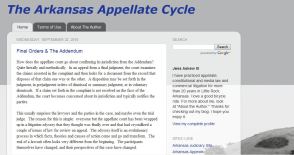
Authored by Jess Askew III of Williams & Anderson, The Arkansas Appellate Cycle Blog combines information about appellate practice and procedure with Mr. Askew’s more than twenty years of experience as an appellate attorney in Arkansas. In his blog posts, Mr. Askew creatively weaves his love for cycling with his passion for appellate practice to provide a helpful frame of reference outside of the law that often helps him explain legal minutiae. Mr. Askew describes his goal with the blog as follows:
My goal is to have a conversation about appellate practice in the state courts of Arkansas, and the cycling perspective can help make a point or two along the way. There is also the natural metaphor between the journey of a bike trip and the life of a lawsuit, from trial through appeal. I hope the cycling perspective will make this blog more accessible and enjoyable.
Check out Mr. Askew’s most recent blog post entitled Final Orders & The Addendum for an example of how he creatively connects the cycling process to Arkansas’s appellate cycle.
Mr. Askew’s resume as an appellate practitioner is impressive. He began his legal career as a law clerk to the late Richard S. Arnold, who sat as a judge and later as Chief Judge on the United States Court of Appeals for the Eighth Circuit. Mr. Askew has been involved in numerous cases on appeal, including the recent cases of Arkansas Blue Cross v. Little Rock Cardiology Clinic, 551 F. 3d 812 (2009), dealing with federal ancillary jurisdiction in a health-care case; Arkansas Democrat-Gazette v. District Court, Ark. S. Ct. No. 08-1435 (Dec. 18, 2008), establishing the availability of a writ of certiorari from a circuit court to an inferior court under Amendment 80 to the Arkansas Constitution; and Cox v. Daniels, 374 Ark. 437 (2008), rejecting a ballot-title challenge to the Arkansas College Scholarship Lottery Amendment under Amendment 7 to the Arkansas Constitution. Additionally, Mr. Askew was a contributor to the Arkansas Bar Association’s treatise on Handling Appeals in Arkansas. Mr. Askew is listed in Best Lawyers in America under appeallate practice.
The experience and knowledge Mr. Askew brings to The Arkansas Appellate Cycle Blog makes it a great new resource for Arkansas appellate lawyers. To follow the blog, click on the links provided in this post or click on the link to The Arkansas Appellate Cycle Blog in our list of Blog Links included in the sidebar to the right.


 ArkansasAppeals.com