Cabot Circuit Court Judge Philip Whiteaker Announces Candidacy for Arkansas Court of Appeals

Cabot Circuit Court Judge Philip Whiteaker

Cabot Circuit Court Judge Philip Whiteaker announced last month that he will be a candidate for District 1, Position 2 of the Arkansas Court of Appeals.  That seat is currently held by Judge Raymond Abramson, who was appointed to that position last year by Governor Mike Bebee.

Because Judge Abramson is serving by appointment, he is unable to run for the seat in the upcoming election.   Earlier this year, Abramson announced his candidacy for the Arkansas Supreme Court seat that is currently held by Justice Jim GunterJustice Gunter announced in May of this year that he will not seek re-election for that position when his term ends in 2012.

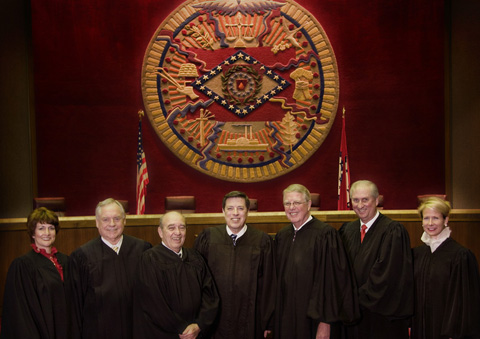
Arkansas Supreme Court Kicks Off 2011-12 Term; Celebrates 175th Birthday

Arkansas Supreme Court
(Arkansas Supreme Court Photo)

The Arkansas Supreme Court kicked off its 2011-12 term with its first oral argument in the old Supreme Court Chamber at the Arkansas State Capitol and a birthday celebration at the Arkansas Supreme Court.  This week marks the 175th birthday of the Arkansas Supreme Court.

The Court handed down its first decisions for its new term on Thursday, September 8, 2011.  Five cases were submitted to the Court for decision on Thursday, September 8, 2011.  Of those five cases, one is a criminal appeal and four are civil matters.

The criminal appeal to be decided by the Arkansas Supreme Court this week, Lemuel Session Whiteside v. State of Arkansas, was the case that was argued orally on Thursday, September 8, 2011, in the Old Supreme Court Chamber at the State Capitol Building.  Attorney Tom Sullivan represented the appellant, an Arkansas teenager who is serving a life sentence for capital murder.  Sullivan argued that the sentence was unconstitutional because the appellant was a minor at the time of the crime and he did not fire the fatal shot.  The Arkansas Supreme Court is expected to hand down a decision in Whiteside, as well as in the civil cases submitted to the Court this week, within the next month.

President Obama Nominates Arkansas Supreme Court Chief Justice Hannah to Serve on National Board

The Arkansas Supreme Court announced in a press release this week that President Obama has nominated Arkansas Supreme Court Chief Justice Jim Hannah to serve on the Board of Directors of the State Justice Institute.

The White House Press Release includes the following biography of Justice Hannah:

Chief Justice Jim Hannah is currently serving as Chief Justice of the Arkansas Supreme Court.  He was first elected as an Associate Justice in 2000 and re-elected as Chief Justice in 2004 and 2008.  He was appointed by President Barack Obama to the Board of Directors of the State Justice Institute in 2010.  Prior to serving on the Arkansas Supreme Court, he served as a Chancery/Probate Judge in the 17th Judicial District from 1979 to 1999.  Chief Justice Hannah maintained a private law practice for ten and a half years before he was elected to the trial bench. While in private practice, he also served as the city attorney for Searcy, Arkansas, as city attorney for several communities in White County, as a city  judge  for Kensett, Arkansas and Rosebud, Arkansas, as deputy prosecuting attorney for Woodruff County, and as the White County Juvenile Judge.   Chief Justice Hannah has served as President on the Board of the Arkansas Judicial Council.  He has served as Chairman of the Arkansas Judicial Resources Assessment Committee, Legislative Committee, and Retirement Committee.  He has also served on the board of the Conference of Chief Justices and is currently serving as Co-Chair of the Committee of Families and Courts.   In addition, he sits on the U.S. Supreme Court Judicial Conference Committee on Federal-State Jurisdiction and the Arkansas Supreme Court Committees on Technology, Child Support, and Foster Care.  Chief Justice Hannah received a B.S.B.A. from the University of Arkansas, Fayetteville, and a J.D. from the University of Arkansas School of Law.

Justice Brown to Retire at the End of 2012

Arkansas Supreme Court Justice Robert L. Brown

Earlier today, Associate Justice Robert L. Brown announced that he will be retiring from the Arkansas Supreme Court at the end of 2012.  At the time of his retirement, Justice Brown will have served for twenty-two years as a justice on the Supreme Court.

Justice Brown has authored over 1,220 majority opinions while on the Supreme Court, including a term-limits decision that was affirmed by the U.S. Supreme Court (U.S. Term Limits v. Hill) and four Lake View decisions (Lake View School District v. Huckabee).

Discussing his retirement, Justice Brown said, “Having served on the court for twenty-two years, it will be time in my case to pass the torch to a new member who will bring fresh thought and vision to the job of supreme court justice.”  Justice Brown also said that he would be “exploring other options in public service.”

The Press Release from the Arkansas Supreme Court has more details about the retirement, and about Justice Brown’s long career in public service.

United States Supreme Court Chief Justice Roberts Reappoints Arkansas’s Chief Justice Hannah to the Judicial Conference Committee

Chief Justice Jim Hannah

Chief Justice Jim Hannah has been reappointed for a three-year term to the Judicial Conference Committee on Federal-State Jurisdiction.   Justice Hannah, who is one of only four state supreme court justices serving on the committee, was first appointed to the committee in 2008.  The full press release from the Arkansas Supreme Court is after the jump.

Continue reading “United States Supreme Court Chief Justice Roberts Reappoints Arkansas’s Chief Justice Hannah to the Judicial Conference Committee”

Rule 54(b)(5) and the Rule of Unintended Consequences: Yet Another Rule 54(b) Trap

In 2008, Rule 54(b) of the Arkansas Rules of Civil Procedure was amended in an effort to resolve a finality problem that kept reoccurring. See Ark. R. Civ. P. 54(b), Addition to Reporter’s Notes, 2008 Amendments.  The problem was that defendants (often “John Doe” defendants) would be added to a complaint, but then those defendants would never be served. See id.  An order would be entered that would be considered by everyone to be final, and one party would then appeal. See id.  However, because there were unserved defendants, the order would not be binding on those parties, and the Supreme Court or Court of Appeals would be forced to dismiss the appeal for lack of a final order.  The purpose of Rule 54(b)(5) was to deal with this situation by providing that once a final order is entered, any claims against named but unserved defendants (including John Doe defendants) are dismissed. See Ark. R. Civ. P. 54(b)(5).

In Global Economic Resources, Inc. v. Swaminathan, 2011 Ark. App. 249, the Arkansas Court of Appeals introduced an interesting twist to the new rule.  The case has a rather lengthy history, as is outlined below.

Trial Court

The case began as a breach of contract action by Global against Susindran Swaminathan and Venkataraman Melpakkam (referred to in the remainder of this blog post as the “Individuals”), doing business as Sabare SCM Solution, Inc. Id. at 1-2.  After the answer was filed, Global filed an amended complaint dismissing the Individuals without prejudice, and adding Sabare SCM Solution, Inc., a Georgia corporation, as a separate defendant. Id. at 2.  The trial court dismissed Sabare SCM with prejudice, holding that the court did not have personal jurisdiction. Id.  Global appealed this order. Id.

First Appeal

Although the trial court had entered an order dismissing Sabara SCM, it had not entered an order in response to Global’s motion to dismiss the Individuals. Id.  Therefore, the Court of Appeals dismissed the appeal for lack of a final order. Id.

Back to the Trial Court

After the dismissal of the first appeal, Global filed another amended complaint. Id. at 2-3.  This complaint included as defendants the Individuals and Sabare SCM, and also added Ganesh Kumar and Sabare USA, Inc., as defendants. Id.  On the same day, Global filed a motion to withdraw its earlier motion to dismiss the Individuals. Id. at 3.  Sabare SCM and the Individuals again raised personal jurisdiction as a defense. Id.  On March 11, 2010, the trial court entered an order dismissing Sabare SCM and Sabare USA for lack of personal jurisdiction. Id.  In the same order, the trial court stated that it was granting Global’s earlier motion to dismiss the Individuals. Id.

After this order was entered, Global claimed to have served Sabare USA. Id. at 4.  Sabare USA moved to quash, arguing that the court did not have personal jurisdiction. Id.  In its response, Global asked that the motion to quash be denied, and also argued that the order dismissing the Individuals was improper because there was no motion to dismiss pending at the time (because Global had withdrawn its motion to dismiss). Id.

On September 30, 2010, the trial court entered an amended order reaffirming the conclusions in its March 11, 2010 order. Id. at 4-5. Six days later, on October 6, 2010, the trial court entered an “amended amended order,” correcting an error not relevant to the subject matter of this blog post. Id. at 5.  On October 25, 2010, Global filed a notice of appeal.

The Second Appeal

On appeal, the Court of Appeals dismissed the appeal, holding that the notice of appeal was not timely filed. Id. at 5-7.  The problem was that after the trial court dismissed the Individuals and Sabare SCM on March 11, 2010, only Sabare USA and Gamesh Kumar remained as parties. Id. Even though Sabare USA was served approximately two weeks after the March 11 order was entered, it had not been served prior to entry of that order (presumably Gamesh Kumar was never served). Id. at 4, 6.  Therefore, these two parties were “named but unserved defendant[s]” pursuant to Rule 54(b)(5), meaning that any claims against them were dismissed at the time the claims against the served parties were dismissed. Id. at 6.  As a result, the March 11, 2010 order was considered the final order for purposes of the notice of appeal, meaning that the October 25, 2010 notice of appeal was not timely filed. Id.

Conclusion

As mentioned above, the intent of Rule 54(b)(5) was to correct previous outcomes that “waste[d] litigants’ time and money and scarce judicial resources.” Ark. R. Civ. P. 54 Addition to Reporter’s Notes, 2008 Amendments.  The rule was meant to resolve the problem created when “a forgotten defendant[s] . . . presence destroys the finality of the judgment being appealed.” Id.  In this case, however, the unserved defendant actually created finality when none was intended, and the result was that the appeal was dismissed with the merits of the case never being addressed by the appellate court.

Related Posts:

Court of Appeals Judge Abramson Announces Candidacy for Arkansas Supreme Court Position

Court of Appeals Judge Raymond Abramson announced his candidacy on Monday for the Arkansas Supreme Court position that is currently held by Associate Justice Jim Gunter.  Justice Gunter announced last week that he plans to retire at the end of his term next year.

Judge Abramson, who practiced law for 34 years in Monroe County, was appointed by Governor Beebe to the Court of Appeals last year following Judge Price Marshall’s confirmation as a federal district court judge.  Abramson is not eligible to run for that position to which he was appointed last year.

Currently, Judge Abramson is the only candidate who has announced his or her intent to run for the position currently held by Justice Gunter.

Arkansas Supreme Court Associate Justice Jim Gunter Will Not Seek Re-Election

The Administrative Office of the Courts announced today that Associate Justice Jim Gunter will not seek re-election when his term ends in 2012.

The Arkansas Times reported in February of this year that Judge Ray Abramson, who is currently serving in an appointed position on the Arkansas Court of Appeals, was planning to run for the Arkansas Supreme Court in 2012. See Arkansas Times: Judge Ray Abramson to Run for Arkansas Supreme Court.  While Judge Abramson has not made an official announcement, the Arkansas Times continues to report that he will run for Justice Gunter’s seat.

Ten Tips to Remember When Filing Your Next Notice of Appeal

Appellate attorneys suggest that you start thinking about the appeal of your client’s case from the moment you file the initial pleading.  The reality is that a lot of lawyers don’t start thinking about the appeal until they are drafting the notice of appeal.  If that’s you, then these ten tips are meant to help when you’re preparing your next notice of appeal.  Although not an exhaustive list of the steps necessary to properly file a notice of appeal, these ten tips will help you jump-start your review of some of the relevant rules.

  1. The notice of appeal must be filed within 30 days of the date the judgment from which you are appealing is entered, and not the date from which it was signed. See Ark. R. App. P.–Civil 4(a).
  2. If the notice of appeal is filed after the circuit court announces its decision, but prior to the entry of the final judgment, your notice of appeal will be treated as though it was filed on the day after the judgment is entered. See Ark. R. App. P.–Civil 4(a).
  3. Effective July 1, 2010, the notice of appeal is required to state, among other things, that “the appealing party abandons any pending but unresolved claim.” Ark. R. App. P.–Civil 3(e)(vi); see also Ark. R. Civ. P. 54(b); see also The Rule 54(b) Trap: Dealing with Non-final Orders in Cases with Multiple Claims or Multiple Parties.
  4. The notice of appeal must designate the specific judgment or judgments from which the appealing party is appealing. See Ark. R. App. P.–Civil 3(e)(ii); see also, e.g., Hall v. Arkansas Dept. of Human Services, 101 Ark. App. 417, 278 S.W.3d 609 (2008) (holding that orders not mentioned in the notice of appeal are not properly before the appellate court).
  5. You must contact the Court Reporter to make financial arrangements to pay for the transcript prior to stating that you have done so in the notice of appeal—and, it’s a good idea to follow up with a letter or email acknowledging that you have done so. See Ark. R. App. P–Civil 3(e)(iv).
  6. The notice of appeal can state that you are appealing directly to the Arkansas Supreme Court, but only in appropriate cases. See Ark. R. App. P–Civil 3(e)(v); see also Ark. Sup. Ct. R. 1-2(a).
  7. You are required to serve a copy of the notice of appeal or notice of cross-appeal upon counsel for all other parties by a form of mail that requires a signed receipt (and not by regular first class mail).  Don’t forget to change your certificate of service to indicate that you have complied with this rule. See Ark. R. App. P.–Civil 3(f).
  8. If the appellant does not designate the entire record and all the proceedings and evidence in his case, then, in addition to the notice of appeal and designation of record, he is required to also serve a concise statement of the points on which he intends to rely on the appeal. See Ark. R. App. P.–Civil 3(g).
  9. The timely filing of a notice of appeal is jurisdictional; thus, the appellate court is required to raise the issue of subject-matter jurisdiction on its own motion. See, e.g., Stacks v. Marks, 354 Ark. 594, 127 S.W.3d 483 (2003) (appeal dismissed where the Court determined on its own motion that the notice of appeal was untimely).
  10. Notices of appeal in the context of post-judgment motions can be tricky, tricky, tricky.  There is no one rule or tip to  summarize the variety of problems that can arise when trying to properly file a notice of appeal in the context of post-judgment motions.  If you plan to file any post-judgment motions in your client’s case, don’t do so before you carefully study the rules and case law with respect to how those motions can affect the deadlines for properly filing the notice of appeal.

Originally published in the Volume 15, Issue #2 of the Arkansas Bar Association’s Young Lawyers Section newsletter, In Brief, available at the following link:  http://issuu.com/arkansas_bar_association/docs/inbrief_spring11?mode=embed&layout=http%3A%2F%2Fskin.issuu.com%2Fv%2Flight%2Flayout.xml&showFlipBtn=true.  Republished here with permission.

Amendment to Ark. Sup. Ct. R. 4-2(b) Gives Appellate Court Option to Avoid Rebriefing When Appellant’s Abstract or Addendum is Deficient

The Arkansas Supreme Court recently amended Arkansas Supreme Court Rule 4-2, which governs contents of briefs on appeal, to give appellate courts an additional option concerning how those courts may handle deficiencies in the appellant’s abstract or addendum. See In Re 4-2(b) of the Rules of the Supreme Court and Court of Appeals, 2011 Ark. 141.  With the recent amendment to Rule 4-2(b), when the Arkansas Supreme Court or the Arkansas Court of Appeals determines that deficiencies in an appellant’s abstract or addendum need to be corrected, but rebriefing is not necessary, the court may order the appellant to file a supplemental abstract or addendum.  If an appellate court allows a supplemental abstract or addendum to be filed, that must be done within 7 calendar days.  This amendment to Rule 4-2(b) became effective March 31, 2011. See In Re 4-2(b) of the Rules of the Supreme Court and Court of Appeals, 2011 Ark. 141

It appears that this amendment to Rule 4-2(b) will have the effect of allowing the appellate courts, in their discretion, to more quickly and efficiently obtain information that was missing from the appellant’s abstract or addendum rather than always requiring rebriefing in those situations.  Where an appellant’s abstract or addendum is deficient or where important documents were omitted, that appellant (or his or her attorney) will save the additional cost of reprinting the entire brief in cases where the appellate court determines that rebriefing is not necessary. 

The Arkansas Supreme Court’s amendment to Rule 4-2(b) reads as follows:

(b) Insufficiency of appellant’s abstract or addendum. Motions to dismiss the appeal for insufficiency of appellant’s abstract or addendum will not be recognized. Deficiencies in the appellant’s abstract or addendum will ordinarily come to the court’s attention and be handled in one of four ways as follows:

. . .

(4) If the appellate court determines that deficiencies or omissions in the abstract or addendum need to be corrected, but complete rebriefing is not needed, then the court will order the appellant to file a supplemental abstract or addendum within seven calendar days to provide the additional materials from the record to the members of the appellate court.Ark

Ark. Sup. Ct. R. 4-2(b)(4).